

Pro Tips & Projects
Smart fixes. Real projects. Straight talk from your local pros.
Keeping a home running smoothly is a full-time job — and most people don’t have the time, the tools, or the patience to figure it all out. That’s where we come in.
Welcome to your go-to hub for expert tips, real project breakdowns, money-saving strategies, and homeowner how-tos — all written in clear, real-world language, never contractor-speak.
Whether you’re trying to stay ahead of problems, plan a remodel, or avoid getting ripped off, you’ll find exactly what you need right here… from pros who do this every day.
No fluff. No guesswork. Just straight-up help you can use.
What You’ll Find Here:
Pro Tips to extend the life of your home
DIY-Friendly Fixes anyone can handle safely
Project Breakdowns from real jobs we've completed
Money-Saving Advice to avoid costly mistakes
Before & After Transformations to spark ideas
Seasonal Checklists to keep your home in top shape
Need Personalized Advice?
If you ever want help with a repair, a renovation idea, or just a second opinion, we’re only a message away.

10 Days of Curb Appeal - Day 7: The Perfect Edge, Professional Edging & Mulch Refresh
10 Days of Curb Appeal - Day 7: The Perfect Edge, Professional Edging & Mulch Refresh
Welcome back to Day 7 of our 10 Days of Curb Appeal series! We've officially crossed the halfway point, and if you've been following along, your Salt Lake Valley home is probably looking pretty sharp right now. But today? Today we're talking about one of those upgrades that separates "nice yard" from "wow, that yard looks professional."
I'm talking about crisp lawn edging and a fresh layer of mulch.
It's funny, most people don't consciously notice edging. But they absolutely notice when it's missing. A lawn without clean edges looks... tired. Overgrown. Like nobody's paying attention. But add that razor-sharp line where grass meets flower bed? Suddenly the whole property looks intentional. Cared for. Like someone who has their life together lives there.
Let's dig into why this simple upgrade packs such a visual punch, and how it actually saves you work in the long run.
Why Edging Makes Such a Big Difference
Here's the thing about lawn edging: it's all about definition.
Think of it like the frame around a painting. The artwork might be beautiful, but without that frame, it just looks... unfinished. Edging does the same thing for your landscaping. It creates clear boundaries between your lawn, flower beds, walkways, and driveways. Everything looks more organized and deliberate.
For homes here in the Salt Lake Valley, whether you're in Herriman, Sandy, West Valley City, or Magna, that definition matters even more. Our yards take a beating. Between the dry summers, the alkaline soil, and the occasional late-spring snowstorm that catches everyone off guard, landscaping can start looking rough around the edges (literally) pretty quickly.
A clean edge says, "This homeowner is on top of things." And that perception matters whether you're planning to sell or just want to be the house on the block that makes the neighbors slightly jealous.
Choosing the Right Edging Material
Not all edging is created equal, and the material you choose should match your budget, aesthetic, and how much maintenance you want to deal with down the road.
Plastic Edging is the most budget-friendly option. It's flexible, easy to install, and works great for curved borders. The downside? Utah's temperature swings can make it brittle over time. If you've ever seen that black plastic edging popping out of the ground like it's trying to escape, you know what I mean.
Metal Edging is often considered the gold standard for professional-looking results. Aluminum won't rust (important for our irrigation-heavy yards), and it creates that clean, barely-visible line that lets your landscaping do the talking. Steel looks great too but can corrode in moist conditions, something to consider if you have sprinklers running regularly.
Rubber Edging is a solid middle-ground option. Made from recycled tires, it's flexible enough to handle curves and tough enough to survive our climate. Plus, it won't crack when your mower bumps into it.
Brick or Stone Edging makes a serious design statement. It's durable, adds visual interest, and comes in tons of colors to match your home's exterior. The trade-off is cost and installation time, laying brick properly takes real effort. But if you're going for that "magazine cover" look, it's hard to beat.
For most Salt Lake Valley homeowners, I usually recommend aluminum edging for longevity or rubber edging for flexibility and value. But honestly? Any edging is better than no edging.
The Mulch Factor: More Than Just Pretty
Okay, so you've got your edges looking sharp. Now let's talk about what goes inside those beds.
Fresh mulch is one of those curb appeal upgrades that looks expensive but really isn't. A few bags of quality mulch (or a bulk delivery if you've got larger beds) can completely transform tired landscaping. That rich, dark color against green plants and a bright lawn? Chef's kiss.
But here in Utah, mulch does way more than look good. It actually helps your plants survive our challenging climate.
Moisture Retention
This is huge for us. The Salt Lake Valley averages around 16 inches of rainfall per year: that's considered semi-arid. Our plants are thirsty, and water bills can get painful during July and August.
A good 2-3 inch layer of mulch acts like a protective blanket, slowing evaporation and keeping that precious moisture in the soil where roots can actually use it. Mulch significantly reduces evaporation and helps soil stay moist longer. That means less watering, lower bills, and happier plants.
Weed Control
Nobody wants to spend their Saturday mornings pulling weeds. Mulch suppresses weed growth by blocking sunlight from reaching weed seeds. It won't eliminate weeds entirely (nothing does), but it dramatically reduces how many pop up: and the ones that do are way easier to pull from soft, mulched soil.
Temperature Regulation
Utah's temperature swings are no joke. We can go from 95°F in the afternoon to 60°F at night during summer. That kind of fluctuation stresses plant roots. Mulch acts as insulation, keeping soil temperatures more stable and giving your landscaping a better chance to thrive.
Soil Health
As organic mulch breaks down over time, it adds nutrients back into the soil. Our Utah soil tends to be heavy on clay and alkaline minerals, so any organic matter you can add is a win. It's like a slow-release vitamin for your flower beds.
Wood Chips vs. Rock: Which Is Right for You?
This is the great Utah landscaping debate. Drive through any neighborhood in Riverton or Herriman and you'll see both: sometimes right next to each other.
Wood Mulch gives you that classic, lush landscaping look. It's better for moisture retention, adds organic matter to soil, and is generally cheaper. The downside is that it breaks down and needs to be refreshed every 1-2 years.
Rock or Gravel is the low-maintenance choice. It won't blow away, doesn't decompose, and fits the desert-modern aesthetic that's popular right now. However, rock doesn't retain moisture as well (it actually absorbs and radiates heat), and weeds can still pop up between stones if you don't have good landscape fabric underneath. Even then, landscape fabric can slow weeds at first, but over time wind-blown soil lets weeds grow on top of the fabric.
Use wood mulch in beds where you want plants to thrive: around trees, shrubs, and perennials. Use rock in areas where you want minimal maintenance and don't mind a hotter microclimate: like around your AC unit or along side yards that don't get much attention.
DIY or Call a Pro?
Basic edging maintenance: using a manual edger or spade to clean up existing edges: is totally doable for most homeowners. Set aside a Saturday morning, put on some good music, and go to town. It's satisfying work.
Installing new edging gets trickier depending on the material. Plastic and rubber are pretty straightforward. Metal edging requires more precision to get those clean lines. And brick or stone? That's a full project requiring proper trenching, leveling, and sometimes a compacted base. Watch for irrigation lines when trenching, they’re often only a few inches below the surface.
Mulch spreading is labor-intensive but not complicated. The challenge is usually just the volume: a few flower beds might need 10-20 bags, and larger properties could require a bulk delivery measured in cubic yards.
If you're short on time, dealing with a large property, or want that truly professional finish, this is a great project to hand off. We handle edging and mulch refreshes all the time for homeowners across the Salt Lake Valley, from Sandy to Magna to West Valley City.
For more tips on maintaining your Utah home, check out our 2026 Homeowner Maintenance Calendar or browse our full Pro Tips & Projects library.
The Bottom Line
Day 7's curb appeal lesson is simple: definition matters. Clean edges and fresh mulch make everything else in your landscaping look better. It's the difference between "fine" and "finished."
Plus, with Utah's dry climate, mulch isn't just cosmetic: it's actually helping your plants survive while saving you money on water.
Ready to give your landscaping that professional edge? Your Handyman Pros serves homeowners throughout the Salt Lake Valley, including Herriman, Riverton, Sandy, West Valley City, and Magna. Give us a call: we'd love to help you check this one off the list.
This is Day 7 of our 10 Days of Curb Appeal series. Missed the earlier posts? Check out Day 2: Outdoor Lighting and Day 3: House Numbers & Mailbox.
10 Days of Curb Appeal - Day 6: Small Fixes, Big Impact, The Power of Caulk & Paint
10 Days of Curb Appeal - Day 6: Small Fixes, Big Impact, The Power of Caulk & Paint
Welcome back to Day 6 of our 10 Days of Curb Appeal series! If you've been following along, you've already tackled some great upgrades, from outdoor lighting to house numbers and mailboxes. Today, we're diving into something that might not sound glamorous but packs a serious punch: caulk and paint touch-ups.
Here's the thing, you could have a gorgeous front porch, beautiful landscaping, and a perfectly pressure-washed driveway. But if your window caulk is cracked and your trim paint is peeling? The whole house looks tired. These "invisible" repairs are what separate a home that looks okay from one that looks well-loved and well-maintained.
Let's talk about how a tube of caulk and a quart of paint can transform your Salt Lake Valley home's curb appeal.
Why Small Fixes Matter More Than You Think
When potential buyers, guests, or even just your neighbors drive by your house, they're not consciously analyzing every detail. But their brains are picking up on the overall impression. Peeling paint, cracked caulk, and weathered trim all send a subconscious message: "This house needs work."
On the flip side, crisp paint lines, sealed windows, and fresh trim communicate care and attention. It's the difference between "that house looks a little rough" and "wow, they really take care of their place."
The best part? These fixes are typically affordable and can often be done in a weekend. Let's break it down.
The Unsung Hero: Caulk
Caulk might be the most underrated home maintenance product out there. It's not flashy, but it does critical work: sealing gaps around windows, doors, and trim to keep moisture, drafts, and pests out of your home.
Where to Check for Caulk Problems
Grab a cup of coffee and take a walk around your house. Look for caulk issues in these spots:
Around window frames – especially where the frame meets the siding
Door frames – both front and back entries
Where siding meets trim – corners and edges are common problem areas
Around exterior light fixtures – water loves to sneak in here
Along the foundation line – where siding meets concrete or stone
What are you looking for? Caulk that's cracked, shrunk away from surfaces, turned yellow or brittle, or is missing altogether. If you can see daylight or feel air coming through, it's definitely time for fresh caulk.
Utah Weather: The Caulk Killer
Here in the Salt Lake Valley: whether you're in Sandy, Herriman, Bountiful, or West Valley City: our weather is particularly brutal on exterior caulk. We're talking:
Temperature swings of 40+ degrees in a single day
Intense UV exposure at our elevation
Freeze-thaw cycles all winter long
Low humidity that dries out sealants faster
Standard caulk might last 5-10 years in milder climates. In Utah? You're looking at 3-5 years before it starts showing wear. That's why we recommend checking your caulk every spring as part of your seasonal home prep.
Choosing the Right Caulk
Not all caulk is created equal. For exterior use in Utah, look for:
Silicone-based caulk for areas that won't be painted (stays flexible longer)
Paintable acrylic-latex caulk for trim and areas you want to paint over
Polyurethane caulk for high-movement areas (more expensive but worth it)
Pro tip: Spend the extra few bucks on quality caulk. That $2 tube from the bargain bin will crack again in a year. A good $8-10 tube will last much longer and save you time and frustration.
Paint Touch-Ups: The Instant Facelift
Fresh paint is like a facelift for your home. But you don't always need to repaint the entire exterior to make a big impact. Strategic touch-ups on key areas can work wonders.
High-Impact Areas to Focus On
Trim and Molding
The trim around your windows, doors, and roofline frames your entire house. Chipped, peeling, or faded trim makes everything look dated. A fresh coat of bright white (or whatever your trim color is) instantly sharpens your home's appearance.
Front Door
We'll cover this more in a future post, but your front door is prime real estate for curb appeal. If it's looking faded or beat up, a fresh coat of paint: maybe even a bold new color: can be transformative.
Railings and Posts
Porch railings, deck posts, and stair balusters take a beating from hands, weather, and time. Touch up chips and scrapes, or give them a complete refresh if they're looking rough.
Shutters
If you have decorative shutters, they're a focal point of your home's facade. Faded or peeling shutters drag down your whole look. Fresh paint makes them pop again.
Garage Door Trim
This is often overlooked, but your garage door takes up a huge percentage of your home's front-facing surface area. The trim around it deserves attention.
Matching Existing Paint Colors
Here's where a lot of DIY touch-ups go wrong: mismatched paint. Even if you have the original can in your garage, paint fades over time. That "perfect match" might look obviously different once it dries.
Tips for better matching:
Bring a chip to the paint store for computer matching
Test in an inconspicuous spot first
Feather the edges of your touch-up into the existing paint
Consider repainting the entire section (one whole shutter, one full piece of trim) rather than spot-touching
DIY vs. Calling a Pro
So when should you tackle caulk and paint yourself, and when should you call in the pros?
Good DIY Projects
Re-caulking a few windows or door frames
Touching up small paint chips on railings or trim
Painting a single shutter or your front door
Sealing gaps along your foundation line
These jobs require basic tools, a steady hand, and a weekend afternoon. YouTube tutorials and a little patience will get you there.
When to Call Your Handyman
High or hard-to-reach areas – second-story windows, high trim, steep rooflines
Extensive caulk failure – if most of your windows need attention
Lead paint concerns – homes built before 1978 may have lead paint that requires special handling
Large paint projects – multiple shutters, all trim, or significant square footage
Wood rot discovery – if you find rotted wood behind bad caulk, that's a bigger repair
Sometimes what looks like a simple paint touch-up reveals bigger issues underneath. A pro can assess whether you're dealing with a cosmetic fix or something more serious.
Your Day 6 Action Checklist
Ready to put the power of caulk and paint to work? Here's your game plan:
This Weekend:
Walk around your home and inspect all exterior caulk
Note areas with cracked, missing, or deteriorated caulk
Check trim, railings, shutters, and doors for paint issues
Make a list of supplies needed
Supplies to Grab:
Quality exterior caulk (silicone or paintable, depending on location)
Caulk gun
Utility knife for removing old caulk
Exterior paint in matching colors
Quality brushes (don't skimp here)
Painter's tape
Drop cloths
Ladder (if needed and you're comfortable using it safely)
The Process:
Remove all old, failing caulk completely
Clean surfaces thoroughly and let dry
Apply new caulk in smooth, continuous beads
Let caulk cure according to package directions
Prep paint areas (clean, sand lightly if needed, tape off)
Apply paint in thin, even coats
Step back and admire your work!
Coming Up Next
Tomorrow in Day 7, we'll explore another high-impact curb appeal upgrade. Stay tuned!
If you're in Sandy, Herriman, Riverton, Magna, West Valley City, or anywhere in the Salt Lake Valley and these small fixes are adding up to a bigger project than you bargained for, we're here to help. Sometimes a Saturday project turns into "actually, I'd rather have a pro handle this": and that's totally okay.
Ready to cross these projects off your list? Contact Your Handyman Pros and let's get your home looking its best this season.
This is Day 6 of our 10 Days of Curb Appeal series. Missed the earlier posts? Check out our Pro Tips & Projects page to catch up!

10 Days of Curb Appeal - Day 5: The Magic of a Power Wash
10 Days of Curb Appeal - Day 5: The Magic of a Power Wash
Welcome back to Day 5 of our 10 Days of Curb Appeal series! If you've been following along, you've already tackled your front door, upgraded your outdoor lighting, refreshed those house numbers, and added some gorgeous greenery. Today, we're bringing out the big guns.
It's time to talk about power washing, the single fastest way to make your home look like it just got a complete makeover without actually changing a thing.
Seriously, if curb appeal had a "cheat code," power washing would be it.
Why Power Washing Feels Like Actual Magic
Here's the thing about dirt, grime, mold, and mildew: they sneak up on you. You see your driveway every single day, so you don't notice that it's slowly turned from "fresh concrete" to "sad parking lot." Your siding? Same deal. That once-bright exterior has been collecting years of Utah dust, pollen, and whatever the wind blows in from the Great Salt Lake.
Then someone comes along with a power washer, and suddenly it's like your house traveled back in time.
Power washing strips away all that accumulated gunk and reveals the original color and texture underneath. We're talking instant transformation. Your driveway goes from grimy gray to clean concrete. Your siding looks freshly painted. Your porch actually looks inviting again.
And here's a fun fact for anyone thinking about selling: homes with strong curb appeal can sell for 5–10% more than comparable properties with neglected exteriors. That's real money, folks.
What Can You Power Wash?
The short answer? A lot more than you probably think. Let's break down the key areas around your Salt Lake Valley home that benefit most from a good power wash.
Driveways and Sidewalks
Your driveway is basically the red carpet leading to your front door. And if that red carpet is covered in oil stains, tire marks, and ground-in dirt... well, it's not exactly rolling out the welcome mat.
Power washing your driveway and sidewalks removes:
Oil and grease stains
Tire marks
Dirt and debris buildup
Algae and moss (especially in shadier spots)
Salt residue from winter de-icing
For homeowners in Sandy, Herriman, Riverton, and throughout Utah Valley, driveways take a beating from our freeze-thaw cycles and road salt. A good power wash in late winter or early spring can wash away all that winter grime and prep your surfaces for the warmer months.
Front Steps and Porch
Your front porch is prime real estate for first impressions. It's where guests wait while you fumble with the door. It's where you sit on summer evenings. It's where delivery drivers snap those "proof of delivery" photos.
And if it's covered in dirt, cobwebs, and mystery stains? Not a great look.
Power washing your front steps and porch can:
Remove built-up dirt and debris
Eliminate slippery algae and mold (safety first!)
Brighten up concrete, stone, or composite materials
Make your new house numbers and flower boxes really pop
Siding (With Caution!)
Here's where things get a little tricky. Yes, power washing can work wonders on your home's siding. But it can also cause serious damage if done incorrectly.
Vinyl siding generally handles power washing well, but you need to use the right pressure setting and angle. Too much pressure or spraying upward can force water behind the siding, leading to moisture problems and mold growth inside your walls. Not good.
Wood siding requires even more care. High pressure can splinter wood, strip paint, and leave you with a bigger project than you started with.
Stucco and brick can also be damaged by overly aggressive power washing, especially if the mortar is older or already deteriorating.
This is one of those areas where calling in a pro really pays off. A Salt Lake handyman who knows their way around a power washer can get your siding sparkling clean without causing damage.
Fences
Wooden fences especially benefit from power washing. Over time, they collect dirt, algae, and that grayish weathering that makes them look decades older than they are.
A thorough power wash can:
Remove surface dirt and grime
Strip away loose paint or stain
Prep the wood for re-staining or sealing
Reveal the natural wood grain underneath
If you're planning to re-stain your fence this spring (great idea, by the way), power washing is an essential first step. It ensures the new stain actually penetrates the wood instead of sitting on top of a layer of gunk.
Decks and Patios
Your deck or patio is basically an outdoor living room. And just like your indoor floors, they need regular cleaning to stay looking their best.
Power washing removes:
Ground-in dirt from foot traffic
Mold and mildew (especially common in shaded areas)
Pollen and plant debris
Food and drink spills from last summer's barbecues
For wooden decks, power washing also preps the surface for sealing or staining: which you should definitely be doing to protect your investment from Utah's intense sun and dramatic temperature swings.
Safety First: Why DIY Power Washing Can Go Wrong
Power washers look simple enough. Point, spray, clean. What could go wrong?
Actually... quite a bit.
The Pressure Problem
Consumer-grade power washers typically run between 1,500-2,000 PSI (pounds per square inch). Professional units can hit 3,000-4,000 PSI or higher. That's enough force to:
Strip paint off surfaces
Gouge wood
Crack or chip concrete
Damage window seals
Seriously injure yourself or others
We're not trying to scare you away from DIY projects (we love a good DIY moment!), but power washing requires respect for the equipment and knowledge of which pressure settings work for which surfaces.
Water Where It Shouldn't Be
As mentioned with siding, improper technique can force water into places it absolutely should not go: behind siding, under roofing, into window frames. This can lead to mold, rot, and water damage that costs way more to fix than a professional power washing would have cost in the first place.
Chemical Concerns
Some power washing jobs benefit from cleaning solutions: degreasers for driveways, mold treatments for shaded areas, etc. Using the wrong chemicals (or mixing them incorrectly) can damage surfaces, harm plants, or create hazardous fumes.
Why Hiring a Pro Makes Sense
Look, we get it. Renting a power washer and tackling your driveway sounds like a satisfying Saturday project. And for some folks, it absolutely can be.
But here's why many Salt Lake Valley homeowners choose to call in a professional:
Time savings. A pro can power wash your entire property in a fraction of the time it would take you to figure out the equipment, do the job, and return the rental.
Better results. Pros know the right pressure settings, techniques, and cleaning solutions for each surface. They get it cleaner without causing damage.
No equipment hassle. No renting, transporting, or storing bulky equipment. No figuring out how to connect hoses and nozzles.
Safety. Pros have experience handling high-pressure equipment safely.
Preventive maintenance. Beyond the cosmetic benefits, regular power washing actually protects your surfaces by removing damaging contaminants like mold, algae, and pollutants. Think of it as preventive care for your home's exterior.
The Salt Lake Valley Advantage
Here in the Salt Lake Valley: whether you're in Bountiful, Sandy, Herriman, West Valley City, Magna, or anywhere in between: our homes face some unique challenges:
Winter salt and de-icer residue that eats away at concrete
Dust and pollen from our dry climate
Algae and mold in shaded areas that don't dry out quickly
Hard water stains from our mineral-rich water
Power washing addresses all of these issues and keeps your home looking its best despite what Utah weather throws at it.
Ready to See the Magic for Yourself?
If your driveway, siding, deck, or porch could use a refresh, Your Handyman Pros is here to help. We serve homeowners throughout the Salt Lake Valley: from Herriman to Bountiful and everywhere in between: with professional power washing services that get results without the risk.
Give us a call or visit our website to schedule your power washing service. Let's make your home shine!
Coming up in Day 6: We're tackling another quick-win curb appeal upgrade that takes your entryway to the next level. Stay tuned!
Missed the earlier posts in this series? Catch up on Day 2: Outdoor Lighting and Day 3: House Numbers & Mailboxes.

10 Days of Curb Appeal - Day 4: The Power of Greenery & Flower Boxes
10 Days of Curb Appeal - Day 4: The Power of Greenery & Flower Boxes
Welcome back to Day 4 of our 10 Days of Curb Appeal series! If you've been following along, you've already tackled your front door, upgraded your outdoor lighting, and modernized your house numbers and mailbox. Nice work!
Today, we're bringing in the big guns: and by big guns, I mean plants. Lots of beautiful, colorful, life-giving plants.
There's something almost magical about what a little greenery can do for a home. It softens those hard architectural lines, adds pops of color that catch the eye, and honestly? It just makes your place feel more alive. Whether you live in Sandy, Herriman, Bountiful, or anywhere else in the Salt Lake Valley, adding flower boxes and planters is one of the easiest ways to level up your curb appeal without breaking the bank.
Let's dig in. (Pun absolutely intended.)
Why Greenery Is a Game-Changer for Curb Appeal
Picture this: You're driving through a neighborhood and you pass two identical houses. One has bare windows, plain concrete steps, and nothing but a stretch of lawn. The other has cheerful flower boxes under the windows, a couple of stylish planters flanking the front door, and maybe some trailing ivy cascading down a porch railing.
Which one catches your eye? Which one feels more welcoming?
Exactly.
Greenery and flowers introduce color, texture, and movement to your home's exterior. They break up flat surfaces, add depth to your entryway, and create that "finished" look that makes people slow down and take notice. Even something as simple as bright yellow pansies or deep purple petunias can transform a plain facade into something that feels polished and intentional.
And here's a bonus: strong curb appeal can help homes sell faster and create a stronger first impression for buyers. Buyers see a well-maintained exterior as a sign that the whole property has been cared for. So even if you're not planning to sell anytime soon, you're building equity just by making your place look good.
Flower Boxes: The MVP of Curb Appeal
If there's one upgrade I'd recommend to almost any homeowner in the Salt Lake Valley, it's window boxes. They're affordable, they're relatively easy to install, and they pack a serious visual punch.
Window boxes work especially well if you:
Have limited yard space
Want quick results without a major landscaping overhaul
Rent your home (many styles attach without causing damage)
Just want to try something new without committing to a full garden
The beauty of flower boxes is their versatility. You can go bold with bright reds, oranges, and hot pinks for a high-energy look. Or you can keep things calm and elegant with whites, soft blush tones, and silvery foliage. The boxes themselves come in all sorts of materials: wood, metal, ceramic, composite: so you can match them to your shutters, your trim, or make them a statement piece all on their own.
What to Plant in Salt Lake Valley
Utah's climate can be a little tricky for gardening. We get hot, dry summers and cold winters, plus that lovely alkaline soil. But don't worry: there are plenty of plants that thrive here.
For sunny spots, try:
Petunias (come in almost every color imaginable)
Geraniums (classic for a reason)
Marigolds (bright and drought-tolerant)
Portulaca (loves the heat)
Ornamental grasses (add texture and movement)
For shadier areas:
Impatiens
Begonias
Coleus (gorgeous foliage colors)
For year-round interest:
Hardy herbs like rosemary or thyme in protected spots
Ornamental cabbage and kale (fall and winter)
Pansies (can handle cooler temps)
Pro tip: Check with your local nursery or reference The Old Farmer's Almanac for planting times specific to our zone. Timing matters!
Beyond the Window: Planters and Container Gardens
Flower boxes are fantastic, but don't stop there. Planters and container gardens give you even more flexibility to add greenery exactly where you want it.
Front porch planters flanking your door create a welcoming entrance. Go with matching pots for a formal look, or mix sizes and styles for something more eclectic and casual.
Step planters can line your walkway or stairs, guiding visitors toward your door while adding color along the way.
Hanging baskets are perfect for porches with overhangs. They draw the eye upward and add dimension to your entryway.
Railing planters work great on decks, balconies, or porch railings: especially if you're short on floor space.
The key is to think about your home's architecture and where the eye naturally travels. You want to enhance what's already there, not overwhelm it. A little goes a long way.
Custom Planter Boxes: When Store-Bought Won't Cut It
Here's the thing about those pre-made planters from the big box stores: they're fine. They do the job. But sometimes your space calls for something more specific.
Maybe you have an awkwardly sized window that standard boxes won't fit. Maybe you want planters that match your deck railing perfectly. Maybe you've got a vision for a built-in planter along your front walkway that would look incredible but doesn't exist in any store.
That's where custom planter box building comes in.
As your local Salt Lake handyman, we can help build what you want. Wood planters, composite material, whatever works for your style and budget. We can match stains to your existing deck or porch, add drainage holes in the right spots, and build them to the exact dimensions your space needs.
It's one of those projects that sounds small but makes a huge difference. And honestly? A well-built custom planter will last way longer than those flimsy store-bought options.
DIY or Call a Pro?
Look, I'm all for DIY projects. Hanging a basic window box or setting out some potted plants? Totally doable for most homeowners.
But there are times when calling in a home repair Salt Lake professional makes sense:
Installing heavy planters at height (safety first!)
Building custom boxes that need to be structurally sound
Attaching planters to stucco or brick without causing damage
Creating integrated planter beds as part of a larger landscaping project
Adding irrigation to keep everything watered automatically
If you're in Herriman, Sandy, Bountiful, or anywhere in the Utah Valley, our team can help with everything from simple installations to full custom builds. We're your handyman Herriman residents trust, your handyman Sandy Utah neighbors rely on, and your go-to handyman Bountiful Utah crew for projects big and small.
Quick Tips for Keeping Your Planters Looking Great
Once you've got your greenery in place, a little maintenance goes a long way:
Water consistently – Container plants dry out faster than in-ground gardens, especially in Utah's dry climate. Morning watering is best.
Deadhead spent blooms – Pinching off faded flowers encourages new growth and keeps things looking fresh.
Feed your plants – A slow-release fertilizer at planting time, plus occasional liquid feeding, keeps colors vibrant.
Rotate seasonally – Swap out annuals as seasons change. Spring pansies give way to summer petunias, then fall mums and ornamental cabbage.
Check drainage – Make sure water can escape. Soggy roots are unhappy roots.
Refresh mulch – A top layer of mulch in your planters helps retain moisture and looks tidy.
Ready to Add Some Life to Your Home?
Greenery and flower boxes are one of those upgrades where you really do get a lot of bang for your buck. They're affordable, they're impactful, and they make your home feel more inviting from the moment someone pulls up to the curb.
Whether you're looking for a simple weekend project or you want custom planters built to fit your space perfectly, we've got you covered. As a licensed and insured home remodel contractor Utah homeowners trust (Lic 12888335-5501), we're here to help with all your curb appeal projects: big or small.
Give Your Handyman Pros a call or check out our other tips and projects for more inspiration.
See you tomorrow for Day 5 of our curb appeal series!

10 Days of Curb Appeal - Day 3: The Instant Upgrade, House Numbers & Mailboxes
10 Days of Curb Appeal - Day 3: The Instant Upgrade, House Numbers & Mailboxes
Welcome back to Day 3 of our 10 Days of Curb Appeal series! If you've been following along, you've already tackled your front door refresh and upgraded your outdoor lighting. Today, we're focusing on something that most homeowners completely overlook, but makes a surprisingly huge impact.
We're talking about your house numbers and mailbox.
Yep, those little details that delivery drivers squint at and guests use to confirm they're at the right place? They're doing a lot more heavy lifting for your curb appeal than you might realize. And the best part? This is one of the fastest, most affordable upgrades you can make. We're talking potentially less than $50 and under an hour of work for a transformation that looks like you spent way more.
Let's dive in.
Why House Numbers and Mailboxes Matter More Than You Think
Here's the thing about curb appeal, it's all about first impressions. And what's literally the first thing someone sees when they approach your home in Sandy, Bountiful, or anywhere across the Salt Lake Valley?
Your mailbox. Your house numbers.
These are the welcome mat before the welcome mat. They signal to visitors, delivery drivers, and yes, potential buyers, how well you maintain your property. Crisp, modern house numbers say "this homeowner pays attention to details." A rusted, leaning mailbox with peeling numbers? Well, that sends a different message entirely.
Think about it from a practical standpoint too. Emergency responders need to find your home quickly. Guests shouldn't have to play detective to figure out if they're at the right address. Clear, visible house numbers aren't just aesthetic: they're functional and important for safety.
Signs It's Time for an Upgrade
Not sure if your house numbers and mailbox need attention? Here are some telltale signs that it's time for a refresh:
Your house numbers are:
Faded, chipped, or peeling
A dated style that doesn't match your home's current look
Hard to read from the street (especially at night)
Missing entirely (it happens more than you'd think!)
The wrong color against your siding or trim
Your mailbox is:
Rusted, dented, or leaning to one side
A style that screams "1985" when your home says "2025"
Difficult to open or close properly
Sitting on a rotting or weathered post
Just plain boring
If any of these sound familiar, congratulations: you've found your Day 3 project!
House Number Upgrade Ideas That Actually Work
When it comes to selecting new house numbers, you've got more options than ever. Here's what we recommend to homeowners across Utah Valley and the greater Salt Lake Valley area:
Choose the Right Style
Modern floating numbers are incredibly popular right now, and for good reason. They create a sleek, contemporary look that works on everything from mid-century ramblers to brand-new builds. These mount slightly off the wall, creating a subtle shadow effect that adds depth and visual interest.
If modern isn't your vibe, no worries. Classic serif fonts, craftsman-style plaques, and even hand-painted tiles can look stunning when they match your home's architecture. The key is intentionality: pick something that complements your home rather than clashing with it.
Master Color and Contrast
This is where a lot of DIYers go wrong. Your house numbers need to contrast with whatever surface they're mounted on. Light house? Go with dark numbers (black, bronze, or deep navy work great). Dark siding or a richly stained door? Bright metallic finishes like brushed nickel, copper, or even gold make your address pop.
For homes in neighborhoods like Sandy or Bountiful where you've got a mix of stucco, brick, and siding, consider what background you're working with. A Salt Lake handyman can help you figure out the best placement and mounting options if you're unsure.
Think About Visibility
Many municipalities recommend numbers large enough to be read from the street. That means size matters. For most single-family homes, 4-6 inch numbers work well for front-door placement, while 6-8 inch numbers are better if they're mounted near the garage or on a pillar farther from the road.
Want to go the extra mile? Consider illuminated house numbers or positioning your numbers under an existing outdoor light. This ensures visibility day and night: something that's especially helpful during those short winter days we get here in Utah. Illuminated numbers should be installed with weather-rated fixtures and proper electrical connections.
Mailbox Makeover: From Eyesore to Eye-Catching
Your mailbox might seem like a small detail, but it's often positioned right at the curb: the very first thing people notice about your property. Here's how to give it the attention it deserves:
Repair or Replace the Post First
A beautiful new mailbox on a rotting wooden post is like putting a fresh coat of paint on a crumbling wall. If your post is leaning, splintering, or just plain ugly, start there. A sturdy new post (wood, metal, or composite) creates a solid foundation. Many Utah Valley handyman services can knock this out in an hour or two.
Match Your Home's Style
Your mailbox should feel like it belongs with your house. Got a craftsman-style home in Bountiful? A copper-topped wooden mailbox would look amazing. Modern build in Daybreak? A sleek black metal box with clean lines is the way to go.
Don't forget about the numbers on your mailbox, either. Matching them to your house numbers creates a cohesive look that ties everything together. Gold or metallic numbers against a dark mailbox are particularly striking.
Add Some Personality
This is curb appeal, after all: have a little fun with it! Consider adding:
A small planter box at the base of your mailbox post
Solar-powered accent lights
A decorative post topper or finial
Seasonal decorations (but keep them tasteful!)
Just remember to check your HOA guidelines if you have them. Some neighborhoods in the Salt Lake Valley have specific rules about mailbox styles and colors. If you’re replacing a curbside mailbox, make sure height and setback follow USPS guidelines so mail delivery isn’t affected.
DIY or Call a Professional?
Here's the honest truth: replacing house numbers is a pretty straightforward DIY project for most homeowners. If you've got a drill, a level, and about 20 minutes, you can probably handle it yourself.
Mailbox installation gets a little trickier, especially if you need to:
Dig out an old concrete footing
Set a new post in concrete
Run electrical for a lighted mailbox
Repair or replace damaged landscaping around the mailbox area
For those projects, calling in a home repair Salt Lake professional makes sense. A handyman Sandy Utah homeowners trust (like our team at Your Handyman Pros) can ensure the post is level, secure, and built to withstand Utah's freeze-thaw cycles.
Local Considerations for Salt Lake Valley Homeowners
Before you run out to the hardware store, keep a few Utah-specific things in mind:
Weather durability matters. Our temperature swings, snow, and occasional wind storms mean you need materials that can handle the elements. Avoid cheap plastic numbers that will crack in the cold. Opt for metal, ceramic, or high-quality composites instead.
HOA rules vary widely. Communities across Sandy, Bountiful, Herriman, and throughout Utah Valley all have different guidelines. Some require specific mailbox styles or limit color choices. A quick check of your CC&Rs can save you from having to redo the project.
Visibility for emergency services. Make sure your numbers are visible from both directions on the street. This is especially important on corner lots or homes set back from the road.
Ready to Make the Swap?
Day 3 is all about those quick wins: the projects that take minimal time and money but deliver maximum visual impact. Upgrading your house numbers and mailbox checks all those boxes.
Whether you tackle this yourself or bring in a handyman Bountiful Utah families count on, the result is the same: a polished, put-together look that makes your whole home feel more welcoming.
Need a hand with installation or want to bundle this project with some of the other curb appeal upgrades we've been covering? Give Your Handyman Pros a call. We serve homeowners throughout the Salt Lake Valley and would love to help you check this one off the list.
See you tomorrow for Day 4!
Your Handyman Pros | Lic #12888335-5501 | Serving Sandy, Bountiful, Herriman, Riverton, and the entire Salt Lake Valley

10 Days of Curb Appeal - Day 2: Brighten Up with Better Lighting
10 Days of Curb Appeal - Day 2: Brighten Up with Better Lighting
Welcome back to Day 2 of our 10 Days of Curb Appeal series! Yesterday we kicked things off with some foundational tips, and today we're diving into something that makes a huge difference, especially here in the Salt Lake Valley where winter nights come early and summer evenings are perfect for hanging out on the porch.We're talking about outdoor lighting.If you've been driving around Herriman, Sandy, or West Valley City at night, you've probably noticed the homes that just pop. The ones with warm, inviting glows that make you want to walk right up and knock on the door. Then there are the ones with that single, flickering yellow bulb from 1997 that's barely hanging on.Don't be the flickering bulb house.The good news? Updating your outdoor lighting is one of the most affordable and impactful curb appeal upgrades you can make. Let's break down exactly how to do it right.
Why Outdoor Lighting Matters More Than You Think
Here's the thing about curb appeal: most people only think about how their home looks during the day. But your house is visible 24/7, and in the Salt Lake Valley, we get dark winter evenings starting around 5 PM for several months.That means your home's nighttime appearance matters just as much as its daytime look.Great outdoor lighting does three important things:Creates a welcoming atmosphere – Warm, well-placed lights make your home feel inviting and lived-inImproves safety and security – Well-lit walkways, driveways, and entry points deter intruders and prevent trips and fallsHighlights your home's best features – That beautiful stonework or landscaping you invested in? It disappears after dark unless you light it upWhether you're planning to sell your home or just want to be the envy of your Riverton neighborhood, better lighting is the way to go.
Start With Your Front Door
Your front entry is the focal point of your home's exterior, so that's where your lighting upgrade should begin.Those old brass coach lights from the 90s? They've served their time. Today's options include sleek modern fixtures, farmhouse-style lanterns, and everything in between. The key is choosing something that complements your home's architecture while providing adequate light.Pro tip from our Salt Lake handyman team: Flank your front door with matching wall-mounted sconces. This creates symmetry and ensures your entryway is well-lit from both sides. If you have a covered porch, consider adding a statement pendant light overhead rated for outdoor or damp locations.When selecting fixtures, pay attention to:Size – Fixtures should be proportional to your door and porch areaFinish – Matte black, brushed nickel, and oil-rubbed bronze are all popular choices that hold up well in Utah's climateBulb type – LED bulbs are the way to go (more on that below)
Light the Path
Nothing says "welcome home" like a beautifully lit walkway leading to your front door. Plus, it's a safety must-have for guests navigating your property after dark.Solar path lights are incredibly popular right now, and for good reason. They're:Easy to install (just stake them into the ground)Cost-effective (no electrical work required)Energy-efficient (they charge during the day and glow at night)Perfect for Utah's sunny climateFor a more permanent solution, low-voltage landscape lighting provides brighter, more consistent illumination. This requires some basic wiring work, but a skilled handyman in Herriman or anywhere in the Salt Lake Valley can knock it out in an afternoon.Space your path lights about 6-8 feet apart for the best effect. You want enough light to see where you're walking without turning your front yard into a runway.
Don't Forget Your Landscape Features
Here's where outdoor lighting gets really fun.Uplighting is a technique where you place lights at ground level and aim them upward to highlight trees, shrubs, or architectural features. That gorgeous tree in your front yard? Put an uplight at its base and suddenly it becomes a stunning focal point at night.Spotlights work similarly but provide a more focused beam. Use them to draw attention to:Mature trees or interesting plant specimensStone walls or retaining wallsColumns or pillarsGarden beds with seasonal flowersThe trick is to be strategic. You don't want to light up everything, that just looks chaotic. Pick two or three features to highlight and let the rest fade into the background. This creates depth and visual interest.If you've invested in xeriscaping or other landscaping improvements (check out our post on 2026 curb appeal upgrades for more ideas), proper lighting ensures you get to enjoy those investments around the clock.
The Layered Lighting Approach
Professional lighting designers talk about "layering" light, and it's a concept that works just as well outdoors as it does inside.Think of it in three categories:Ambient lighting provides overall illumination. This includes your porch lights, post lights at the end of your driveway, or overhead fixtures in covered outdoor spaces.Task lighting serves a specific purpose. Motion-sensor lights near your garage, lights illuminating your house numbers, or bright fixtures near outdoor cooking areas all fall into this category.Accent lighting is purely decorative. String lights on your patio, uplights on your trees, or small fixtures highlighting garden art add personality and charm.When you combine all three layers, you get a rich, dimensional lighting scheme that looks intentional and polished, not like you just screwed in a few bulbs and called it a day.
Go LED and Save Money
If there's one piece of advice every home repair Salt Lake expert will give you, it's this: switch to LED.LED bulbs use up to 75% less energy than traditional incandescent bulbs and often last many times longer than incandescent bulbs. They've come a long way from those harsh, bluish-white lights of the early days. Today's LEDs come in warm white tones that look just as cozy as old-school bulbs.For outdoor use, LEDs are especially smart because:They perform well in cold temperatures (hello, Utah winters)They turn on instantly without warming upThey're more durable and resistant to breakageThey don't attract as many bugsYes, LED fixtures cost a bit more upfront, but the energy savings and longevity make them a no-brainer for Salt Lake Valley homeowners looking to upgrade their home repair Salt Lake style.
Smart Lighting: Worth the Hype?
Smart outdoor lights let you control everything from your phone. Turn lights on and off remotely, set schedules, adjust brightness, and even change colors if you're feeling festive.Are they necessary? No. Are they convenient? Absolutely.If you travel frequently or just want the peace of mind of being able to check on your lights from anywhere, smart bulbs or smart switches are a solid investment. Many work with Alexa, Google Home, or Apple HomeKit, so they integrate seamlessly with whatever smart home system you already have.
DIY or Call a Pro?
Some lighting upgrades are easy DIY projects:Swapping out existing fixtures for new ones (as long as the wiring is already there, but make sure you shut off power at the breaker before the swap)Installing solar path lightsAdding plug-in string lights to your patioOther projects benefit from professional help:Running new electrical lines for landscape lightingInstalling hardwired low-voltage systemsAdding new outlet locations for outdoor useMounting fixtures in difficult-to-reach spotsIf you're not comfortable working with electrical, don't risk it. Our team handles lighting upgrades all the time for homeowners in Magna, Sandy, West Valley City, and throughout the Salt Lake Valley. It's a quick job that makes a lasting impact.
Ready to Light It Up?
Outdoor lighting is one of those upgrades that pays off every single night. It makes your home safer, more welcoming, and way more attractive: whether you're pulling into the driveway after a long day or hosting friends on a summer evening.Tomorrow we'll be back with Day 3 of our curb appeal series. In the meantime, take a walk outside tonight and evaluate your current lighting situation. What's working? What's not? Where could you use a little more glow?If you need a hand with your lighting upgrade: or any other home repair project: reach out to Your Handyman Pros. We're your local Salt Lake handyman team, proudly serving Herriman, Riverton, Sandy, Magna, West Valley City, and the entire Salt Lake Valley.Licensed and insured contractor Lic #12888335-5501
This is Day 2 of our 10 Days of Curb Appeal series. Missed Day 1? Check out our Pro Tips and Projects page to catch up!

The Difference Between a Cosmetic Fix and a Structural Fix
The Difference Between a Cosmetic Fix and a Structural Fix
Let's be honest: when something looks wrong in your home, your first instinct is usually to cover it up. A crack in the wall? Slap some spackle on it. Stained ceiling? Fresh coat of paint. We get it. But here's the thing: not every problem in your Salt Lake Valley home is skin deep.
After years of working on homes across Sandy, Herriman, Bountiful, and everywhere in between, we've seen countless homeowners accidentally make small problems into expensive nightmares: all because they didn't know the difference between a cosmetic fix and a structural fix.
So let's break it down. Because knowing when you can DIY a quick touch-up versus when you need to call a home remodel contractor in Utah could save you thousands of dollars (and a whole lot of stress).
What Exactly Is a Cosmetic Fix?
Cosmetic repairs are all about appearances. They restore how something looks without affecting how it works or how safe it is. Think of it like putting on makeup: it enhances the surface, but it doesn't change what's underneath.
Common cosmetic fixes include:
Repainting walls or ceilings
Replacing cabinet hardware (knobs, pulls, hinges)
Installing new light fixtures (Note: If a ‘simple’ fixture swap involves new wiring, call a licensed electrician)
Swapping out flooring (carpet, laminate, tile)
Patching minor drywall dings and nail holes
Updating faucets and showerheads
Adding new trim or baseboards
These projects are typically faster, more affordable, and sometimes even DIY-friendly. A cosmetic fix is perfect when there's nothing fundamentally wrong: you just want things to look better or feel more modern.
For example, if you're prepping your Herriman home to sell and want to boost curb appeal, a fresh exterior paint job or new door hardware can make a big impact without breaking the bank. That's a cosmetic win.
What Is a Structural Fix?
Now here's where things get serious. Structural repairs address the bones of your home: the hidden framework that keeps everything standing, safe, and functional.
Common structural fixes include:
Foundation crack repair or stabilization
Load-bearing wall modifications or reinforcement
Roof truss repairs or replacement, which often requires an engineer’s input
Floor joist reinforcement
Fixing sagging or uneven floors
Addressing major water damage to framing
Repairing compromised support beams
Structural problems often hide behind walls, under floors, or in attics: places you don't look at every day. That's what makes them so sneaky. A small crack in your drywall might just be settling, or it could be a sign that your foundation is shifting. The difference matters.
Here in Utah, our unique climate puts extra stress on homes. The freeze-thaw cycles, clay-heavy soil (especially in areas like West Valley City and Magna), and our dry summers can all contribute to foundation movement and structural wear over time. If you haven't already, check out our post on why Utah homes age differently for more on this.
Why You Should Never Mask a Structural Problem with a Cosmetic Fix
This is the part where we get real with you.
Some homeowners think covering the problem is the same as fixing it. Whether it's painting over water stains on the ceiling without fixing a roof leak, installing new flooring directly over a rotting subfloor, or wallpaper covering up major foundation cracks, some homeowners might think a visual fix is enough. You shouldn’t rely on cosmetic fixes to solve structural problems.
Here's the harsh truth: cosmetic fixes don't stop structural damage from getting worse. They just hide it: temporarily.
And while that fresh paint might look great for a few months, the underlying problem keeps progressing. Water keeps seeping. Cracks keep spreading. Floors keep sagging. By the time you finally address it, what could have been a $2,000 repair is now a $15,000 project.
Even worse? If you’re selling your home, covering structural issues can create disclosure and inspection problems. Inspectors are trained to spot these cover-ups, and buyers don't take kindly to surprises.
How to Tell the Difference: Red Flags to Watch For
So how do you know if that crack in your wall is just cosmetic or something more serious? Here are some telltale signs that you might be dealing with a structural issue:
Foundation concerns:
Cracks wider than 1/4 inch (especially diagonal or stair-step patterns)
Doors and windows that suddenly stick or won't close properly
Visible gaps between walls and ceiling or floor
Uneven or sloping floors
Roof and framing issues:
Sagging roofline or ceiling
Cracked or split roof trusses (visible in attic)
Bouncy or soft spots in floors
Walls that bow or lean
Water damage red flags:
Recurring water stains (even after "fixing" them)
Musty smells in basements or crawl spaces
Soft or spongy drywall
Visible mold growth
One sign alone may not mean structural trouble, but patterns or multiple symptoms are worth a pro inspection. If you notice any of these signs in your Sandy, Bountiful, or Riverton home, don't just paint over them. Get a professional assessment first.
The Cost Difference: Why Skipping Structural Repairs Costs More
Let's talk numbers for a second.
Cosmetic repairs are generally budget-friendly. A gallon of paint runs $30-50. New cabinet hardware might cost $100-200 for your whole kitchen. Even hiring a Salt Lake handyman to do minor touch-ups is usually in the hundreds, not thousands. Costs vary by access, severity, materials, and whether engineering or permits are required.
Structural repairs? That's a different ballgame.
Foundation crack repair: $500-$3,000+
Foundation stabilization: $5,000-$15,000+
Load-bearing wall modification: $1,500-$10,000+
Roof truss repair: $500-$5,000+
Major water damage restoration: $2,000-$20,000+
The real kicker is that structural problems almost always get more expensive over time. That $800 foundation crack you ignore today could compromise your entire home's stability in five years.
We've written about common home repair mistakes Utah homeowners make: and delaying structural repairs is right at the top of the list.
When to DIY and When to Call a Pro
Look, we love a good DIY project. Painting a room? Go for it. Swapping out a light fixture? Have at it if you’re comfortable and it’s a straightforward replacement. Otherwise, call a licensed electrician. Installing new flooring over a solid subfloor? Absolutely doable.
But here's our rule of thumb: if it affects the safety or stability of your home, call a professional.
Structural work often requires:
Permits and inspections
Engineering assessments
Specialized equipment
Knowledge of load distribution and building codes
Proper materials and techniques
This isn't the place to learn on YouTube. One wrong move with a load-bearing wall can literally bring down part of your house.
How Your Handyman Pros Can Help
With over 30 years of experience serving homeowners across the Salt Lake Valley: from Herriman to Bountiful, Sandy to Magna: we've seen it all. And we handle it all, too.
Need a cosmetic refresh before listing your home? We've got you covered with painting, flooring, trim work, and more.
Worried that crack in your wall might be something serious? We'll assess it honestly and give you a straight answer: no upselling, no scare tactics.
Dealing with actual structural concerns? We work with trusted engineers and specialists to make sure the job gets done right.
Whether you need a Utah Valley handyman for a quick fix or a home repair Salt Lake team for a bigger project, we're here to help you protect your investment. We're a licensed and insured B100 General Contractor and will coordinate with individually licensed and insured trade specialists as needed to cover all of your homeowner needs.
The Bottom Line
Understanding the difference between cosmetic and structural fixes isn't just about saving money: it's about keeping your family safe and your home standing strong for decades to come.
When in doubt, don't cover it up. Get it checked out. Your future self (and your wallet) will thank you.
Ready to get a professional opinion on that repair you've been putting off? Contact Your Handyman Pros today and let's take a look together.
Your Handyman Pros proudly serves Sandy, Herriman, Bountiful, Riverton, West Valley City, Magna, and the entire Salt Lake Valley. Licensed and insured. Lic #12888335-5501

What a General Contractor Notices in 10 Minutes That Homeowners Miss for Years
What a General Contractor Notices in 10 Minutes That Homeowners Miss for Years
You know that feeling when you take your car to a mechanic and they immediately point out three things you had no idea were wrong? That's pretty much what happens when a general contractor walks through your home.It's not that homeowners aren't paying attention: you absolutely are. But there's a big difference between living in a space every day and having trained eyes that know exactly what to look for. A seasoned home remodel contractor in Utah can spot potential disasters in the first ten minutes of a walkthrough that homeowners have walked past for years without a second glance.Here's the thing: catching these issues early doesn't just save you money. It saves you stress, prevents emergency repair situations, and keeps your family safe. So let's talk about what the pros see that you might be missing.
Foundation Cracks: The Silent Story Your Walls Are Telling
One of the first places any experienced contractor looks is at the foundation: and not just the obvious spots. Sure, a massive crack in your basement wall would catch anyone's attention. But what about those hairline cracks in the corners of your window frames? Or that subtle diagonal crack running from the top corner of your doorway?To most homeowners, these look like normal settling. And sometimes they are. But to a trained Salt Lake handyman, these small cracks can sometimes indicate deeper issues like foundation movement, soil shifting, or moisture-related stress.Utah's unique soil conditions: especially the clay-heavy soils common throughout the Salt Lake Valley: cause foundations to expand and contract with moisture changes. A pro knows exactly which crack patterns are cosmetic and which ones are screaming for attention.
Water Stains: The Ghosts of Leaks Past
Here's something that surprises a lot of homeowners: that faint yellowish ring on your ceiling? A contractor spotted it the moment they walked in the room. You probably stopped noticing it three years ago.Water stains are like crime scene evidence. They tell us where water traveled, how much there was, and sometimes even when it happened. A handyman in Sandy, Utah or anywhere in the valley knows that a water stain isn't just an eyesore: it's a clue. Sometimes the leak is long gone, but without inspection, you don’t know whether it’s dormant or still active.The real concern isn't always the stain itself. It's what's happening behind the drywall. Is there mold growing? Has the wood framing started to rot? Is the leak still active, or was it a one-time event? These are questions that require investigation, and they're questions most homeowners don't think to ask until the ceiling starts sagging.For more on avoiding water damage disasters, check out our post on common water damage mistakes Salt Lake homeowners make.
Sloping Floors: When "Character" Is Actually a Problem
Older homes have character. We get it: those creaky floors and slightly uneven surfaces are part of the charm. But there's a difference between a home that's settled gracefully over decades and a floor that's actively sloping because of a structural issue.A Utah Valley handyman can feel a slope the moment they step into a room. Sometimes it's as subtle as a marble rolling slowly across the floor. Other times it's more obvious: doors that won't stay open, gaps appearing between the floor and baseboards, or furniture that never seems to sit level.Sloping floors can indicate:Foundation problemsRotting floor joistsImproper support beam placementWater damage in the subfloorPest damage (including termites, which are less common but still present in parts of Utah)The tricky part? Most homeowners adapt to sloping floors without realizing it. Your brain literally adjusts, and you stop noticing. A contractor's fresh perspective catches it immediately.
Poor Ventilation: The Invisible Threat
This one's huge, especially in Utah. Our dry climate tricks a lot of homeowners into thinking ventilation isn't a big deal. But poor ventilation causes problems that can take years to show up: and by then, the damage is done.A professional handyman in Bountiful, Utah or anywhere in the Salt Lake Valley will check your bathroom fans, attic ventilation, and dryer vents within minutes of entering your home. Why? Because improper ventilation leads to:Moisture buildup and mold growthIce dams on your roof in winter (Poor ventilation combined with insulation and air-sealing issues can cause this issue)Premature aging of roofing materialsHigher energy billsPoor indoor air qualityThat bathroom fan that sounds like a jet engine? It might not actually be venting outside: it could be dumping moisture straight into your attic. That dryer that takes two cycles to dry your clothes? The vent might be clogged, creating a serious fire hazard.These aren't things most homeowners check regularly. But a contractor? It's second nature.
Mismatched Circuit Breakers: A Shocking Discovery
Electrical panels are one of those "out of sight, out of mind" areas of the home. Most homeowners only open the panel when something trips, flip the breaker, and move on. But a home repair Salt Lake professional takes a closer look: and what they find can be alarming.Mismatched circuit breakers are more common than you'd think, especially in homes that have been remodeled over the years. Previous owners (or DIY enthusiasts) may have swapped in breakers that don't match the panel manufacturer. This isn't just a code violation: it's a fire hazard.Other electrical red flags contractors spot quickly:Double-tapped breakers (two wires connected to one breaker)Aluminum wiring with improper connectionsOverloaded circuitsMissing GFCI protection in bathrooms and kitchensBurn marks or corrosion inside the panelYou might have lived with these issues for years without a problem. But "without a problem yet" is the key phrase. Electrical issues often occur without obvious warning.
The "Previous Owner Special"
Every contractor has stories about walking into a home and immediately spotting DIY disasters from previous owners. We're talking about:Load-bearing walls that were "opened up" without proper supportPlumbing drain lines with improper slopeDecks attached with nails instead of proper lag boltsHVAC ductwork held together with duct tape (ironic, right?)Permits that were never pulled for major workA handyman in Herriman or anywhere in the valley has seen it all. These "temporary fixes" that previous owners made often become permanent problems that current homeowners inherit without knowing.We actually wrote a whole post about temporary fixes that aren't really temporary: it's worth a read if you've ever wondered what shortcuts might be hiding in your walls.
Why Early Detection Matters
Here's the bottom line: every issue we've talked about is fixable. Foundation cracks can be repaired. Water damage can be remediated. Electrical panels can be updated. The difference is whether you catch these problems early or wait until they become emergencies.A small foundation crack that might cost around $300 to repair today could become a $15,000 foundation replacement if ignored for another five years. A minor roof leak that's around $500 to fix now could lead to $10,000 in mold remediation and structural repairs down the road.This is why having a trusted contractor walk through your home periodically: even when nothing seems wrong: is such a smart investment. Think of it like a physical for your house.
Your Salt Lake Valley Home Deserves Expert Eyes
At Your Handyman Pros, we've been helping homeowners across the Salt Lake Valley catch these hidden issues before they become major headaches. Whether you're in Sandy, Bountiful, Herriman, or anywhere in between, our team knows exactly what to look for: and more importantly, how to fix it right.Not sure what might be lurking in your home? Reach out to us for a walkthrough. Sometimes ten minutes with a pro can save you ten years of problems.Because your home is talking. The question is whether anyone's listening.
Your Handyman Pros proudly serves the entire Salt Lake Valley, including Sandy, Bountiful, Herriman, Riverton, Magna, and West Valley City. Licensed (#12888335-5501) and insured.
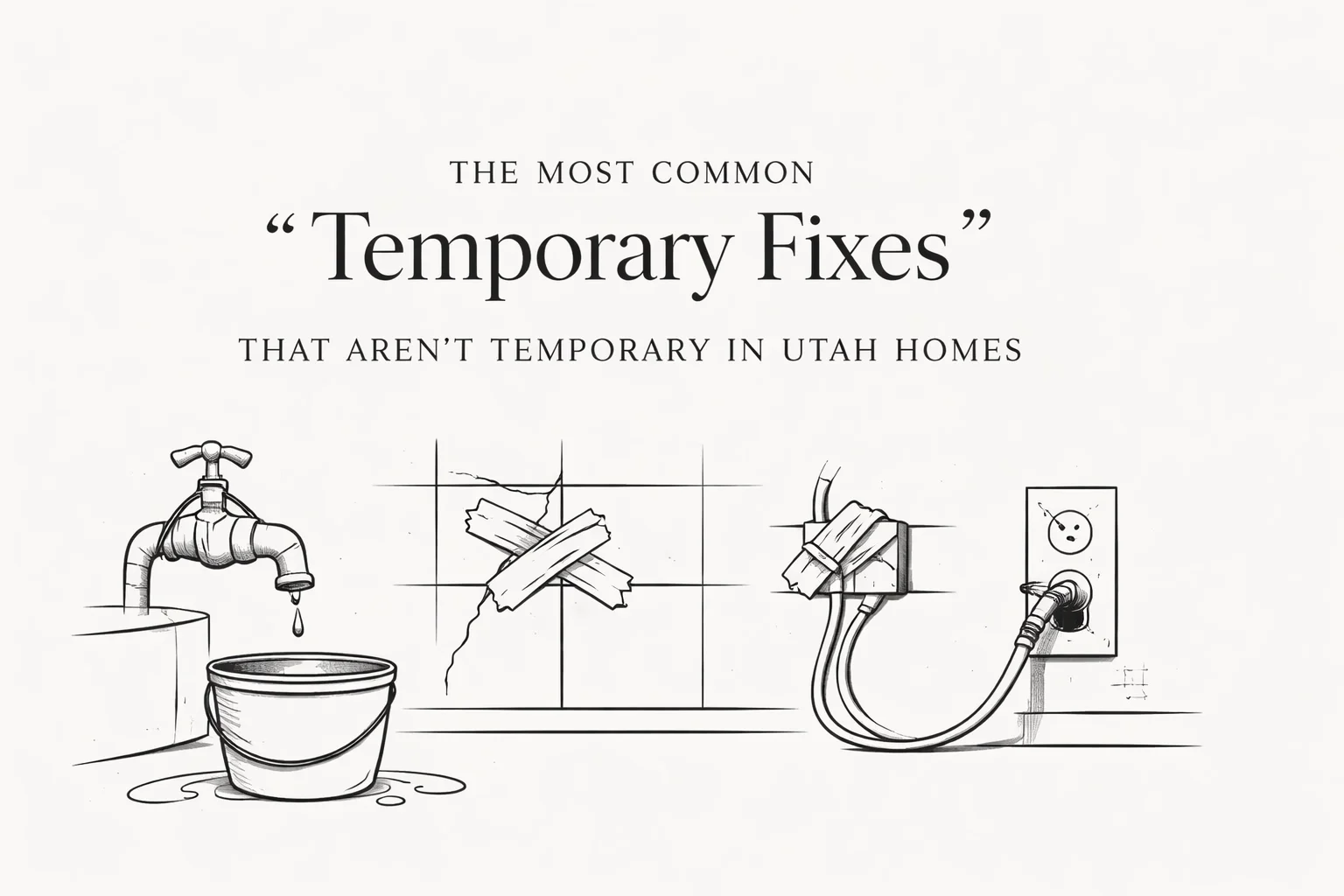
The Most Common "Temporary Fixes" That Aren't Temporary in Utah Homes
The Most Common "Temporary Fixes" That Aren't Temporary in Utah Homes
We've all been there. Something breaks, you don't have time to deal with it properly, and you slap on a quick fix with the full intention of coming back to do it right. "I'll get to it this weekend," you tell yourself.
Fast forward six months, or six years, and that duct tape is still holding your pipe together. That "temporary" shim under your deck railing? It's basically load-bearing now.
We get it. Life is busy. But here's the thing: Utah's unique climate turns those band-aid solutions into ticking time bombs faster than you might think.
Let's talk about the most common "temporary" fixes that Utah homeowners make, and why they almost always lead to bigger, more expensive problems down the road.
Why Utah's Climate Is Especially Tough on Quick Fixes
Before we dive into the specific fixes, it's worth understanding why Utah is particularly unforgiving when it comes to half-measures.
As we covered in our post about why Utah homes age differently, our state throws a lot at your home. We're talking:
Extreme temperature swings , From blazing summer heat to freezing winter nights, sometimes within the same week
Low humidity , Dries out materials like wood, caulk, and sealants faster than in humid climates
High elevation , Increased UV exposure breaks down adhesives and plastics quicker
Freeze-thaw cycles , Water gets into cracks, freezes, expands, and makes small problems into big ones
That "temporary" fix that might last years in a milder climate? In Herriman or Sandy, it can fail much faster than in milder climates. And when it does, you're usually looking at way more damage than you started with.
The Duct Tape Pipe "Repair"
Ah, duct tape. The unofficial mascot of temporary repairs everywhere.
Pipes wrapped in layer upon layer of duct tape and electrical tape seem like a great way to stop pesky leaks. Sometimes there's even plastic wrap involved. It's creative, we'll give you that.
Here's the problem: duct tape adhesive breaks down when exposed to moisture. And Utah's dry air actually accelerates that process because the tape dries out, loses its grip, and eventually fails, usually at 2 AM on the coldest night of the year.
What started as a small pinhole leak becomes a burst pipe, water damage, and potentially mold remediation. What starts as an easy pipe repair can easily turn into a $5,000 headache.
The fix: If you notice a leak, shut off the water to that line and call a professional right away. A proper repair takes an hour or two. Ignoring it takes months off your home's life.
The "Quick Patch" Drywall Job
We've all seen it, maybe even done it. A hole in the drywall gets covered with a piece of cardboard, some spackle slapped on top, and a coat of paint that doesn't quite match.
"Good enough for now," right?
Here's what happens in Utah: our dry climate causes drywall and joint compound to behave differently than in humid areas. Poorly applied patches crack faster. They don’t restore the wall’s integrity, which can allow moisture or pests to continue entering.
Even worse, many of these quick patches hide underlying issues. That hole in your bathroom wall might be covering up water damage or mold. That crack in your living room could indicate foundation settling, a real concern in parts of Sandy, Herriman, and Utah Valley where soil conditions vary widely.
The fix: Proper drywall repair isn't just cosmetic. A handyman Bountiful Utah or anywhere in the valley can assess what's behind that wall before patching it correctly with the right materials and finish.
Deck Shims That Become Structural
Got a wobbly deck railing? Shove a shim in there. Post not quite level? Wedge something underneath.
We see this constantly on decks throughout the Salt Lake Valley. And look, shims have their place. But they're meant for fine adjustments during installation, not as a permanent structural solution.
Utah's freeze-thaw cycles are brutal on decks. Wood expands and contracts. Posts shift. And those shims? They work their way loose, split, or rot. Suddenly your "stable" railing isn't so stable anymore.
This is especially concerning in areas like Herriman and Riverton where many homes have elevated decks. A failing railing at height isn't just an inconvenience, it's a safety hazard.
The fix: If your deck is showing signs of instability, it's time for a proper assessment. A handyman Herriman or Salt Lake Valley handyman can evaluate whether you need minor repairs or if there are bigger structural issues at play. Check out our spring home prep checklist for deck inspection tips.
Caulk: The Universal "Solution"
Caulk is amazing. It seals gaps, prevents drafts, and keeps water out. But somewhere along the way, it became the go-to fix for problems it was never meant to solve.
Cracked tile? Caulk it. Gap in the siding? Caulk it. Window frame pulling away from the wall? You guessed it, caulk.
The issue is that caulk is a sealant, not a structural repair. In Utah's climate, caulk dries out and cracks faster due to our low humidity and UV exposure. When it fails, all those underlying problems you covered up are still there, often worse.
Some homeowners use caulk used to "fix" everything from leaky windows to foundation cracks. Spoiler alert: it doesn't work for long, and it often masks issues that need professional attention from a home remodel contractor Utah families can trust.
The fix: Use caulk for what it's meant for, sealing joints and small gaps. For anything structural or water-related, call in a pro.
Extension Cords as Permanent Wiring
This one genuinely worries us.
It starts innocently enough. You need an outlet where there isn't one, so you run an extension cord. Maybe you tuck it under a rug or along the baseboard. Temporary, right?
Except now it's been there for three years, and you've plugged a power strip into it with six devices attached.
Extension cords are designed for temporary use. They're not rated for permanent installation, especially not under rugs where they can overheat. In dry climates like Utah, the fire risk increases.
The fix: If you need more outlets, get them installed properly. A professional can often add outlets affordably, and it's infinitely safer than that daisy-chained extension cord situation you've got going.
The Real Cost of "I'll Fix It Later"
Here's what we've learned after years of home repair Salt Lake and surrounding areas: the cost of a proper repair is almost always less than the cost of fixing what happens when a temporary repair fails.
That $200 plumbing fix? It can cost up to $3,000 when the pipe bursts and floods your basement.
That $150 drywall repair? It can run up to $2,500 when you discover mold behind the patch.
That $400 deck repair? Costs might get as high as $8,000 when the whole structure needs replacing because the support posts rotted out.
We're not trying to scare you, okay, maybe a little: but we want you to understand that "temporary" fixes have a way of becoming permanent problems. And Utah's climate accelerates that timeline.
When It's Time to Call the Pros
Look, we're not saying every little thing needs a professional. But if your temporary fix involves any of the following, it's time to pick up the phone:
Water or plumbing : Leaks don't fix themselves and always get worse
Structural elements : Decks, railings, load-bearing walls, foundations
Electrical : Never worth the risk
Anything that's been "temporary" for more than a month : At that point, it's not temporary anymore
Whether you're in Sandy, Bountiful, Herriman, Magna, West Valley City, or anywhere in the Salt Lake Valley, our team at Your Handyman Pros is here to help you turn those band-aid fixes into proper repairs.
Check out our post on common home repair mistakes for more on what to avoid, or swing by our Pro Tips page for seasonal maintenance advice.
Because the best time to fix something right is before the temporary fix fails. The second best time? Today.
Your Handyman Pros serves homeowners throughout the Salt Lake Valley, including Sandy, Herriman, Bountiful, Riverton, Magna, West Valley City, and Utah Valley. Contact us for a free estimate on turning your "temporary" fixes into permanent solutions.

Why Homes in Utah Age Differently Than Homes in Other States
Why Homes in Utah Age Differently Than Homes in Other States
If you've moved to Utah from another state, you've probably noticed something: your home doesn't behave the same way it did back in California, Texas, or the Midwest. Paint peels faster. Concrete cracks in weird patterns. Your HVAC system works overtime.
It's not your imagination. Homes in the Salt Lake Valley genuinely age differently than homes in other parts of the country. And understanding why can save you thousands in repairs: plus a whole lot of frustration.
Let's break down what makes Utah so unique when it comes to home maintenance and aging.
Utah's Climate Is a One-Two Punch
Most states deal with one major climate challenge. Florida has humidity. Arizona has heat. The Pacific Northwest has rain.
Utah? We get it all: just compressed into a single year.
Extreme Temperature Swings
In Salt Lake Valley, it's not unusual to experience 100°F summers and sub-zero winter nights. That's a temperature swing of over 100 degrees throughout the year. For your home, this creates constant expansion and contraction in materials like wood, concrete, metal, and even vinyl siding.
Over time, this stress leads to cracks, warping, and premature wear that you simply wouldn't see in milder climates.
The Freeze-Thaw Cycle
Here's the real kicker. Water seeps into tiny cracks in your foundation, driveway, or exterior walls. When temperatures drop, that water freezes and expands. Then it thaws. Then it freezes again.
Repeated freeze–thaw cycles are common in Utah. Every cycle makes those cracks a little bigger. It's why a small foundation crack in Herriman can become a major structural issue within just a few years if left alone.
How Different Parts of Your Home Age in Utah
Let's get specific. Here's how Utah's unique conditions affect different areas of your home: and what you can do about it.
Roofing: Sun and Snow Take Their Toll
Utah's high elevation means more intense UV exposure. Your roof absorbs more solar radiation here than it would at sea level. That breaks down asphalt shingles faster, causing them to become brittle and lose their protective granules.
Then winter hits. Heavy snow loads stress your roof structure, and ice dams can form along the eaves: especially in Sandy, Bountiful, and other valley communities where snowfall varies by neighborhood.
Tip: Have your roof inspected annually. A trusted Salt Lake handyman can spot early signs of UV damage or ice dam vulnerability before they become expensive problems.
Foundations and Concrete: Soil Matters
Utah's soil is notoriously difficult. In many parts of the valley: especially West Valley City, Magna, and parts of Herriman: you'll find expansive clay soils that swell when wet and shrink when dry.
This constant movement puts pressure on foundations, causing cracks, uneven floors, and sticking doors. It's a completely different challenge than what homeowners face in sandy Florida soil or the rocky terrain of New England.
Tip: Keep an eye on drainage around your home. Poor grading sends water toward your foundation, accelerating soil movement and damage. If you notice cracks forming, consult a home remodel contractor Utah trusts for foundation assessments.
Exterior Paint and Siding: Arid Conditions Win
Our arid climate pulls moisture out of wood and paint, causing exterior finishes to dry out, crack, and peel faster than in more humid states. A paint job that lasts 10 years in Ohio might only last 5-7 years here.
Tip: Choose high-quality exterior paints rated for UV resistance and dry climates. And don't skip the primer: it's your first line of defense.
Pipes and Plumbing: Hard Water and Cold Snaps
Utah's water is notoriously hard, meaning it's loaded with minerals like calcium and magnesium. Over time, these minerals build up inside your pipes, reducing water flow and stressing fixtures.
Add in our cold winters, and you've got a recipe for frozen pipes: especially in older homes in Bountiful, Sandy, or anywhere pipes run through uninsulated exterior walls.
Tip: Consider a water softener to reduce mineral buildup. And before winter hits, make sure exposed pipes are properly insulated. Need help? Check out our guide on winter plumbing fixes for Utah homeowners.
HVAC Systems: Working Overtime
Remember those extreme temperature swings? Your heating and cooling system feels every degree of them.
In Utah, HVAC systems work harder and longer than in moderate climates. Scorching summers push your AC to the limit. Frigid winters demand constant heating. This accelerated wear means Utah homeowners may need to replace HVAC components years earlier than homeowners in temperate states.
Tip: Change your filters regularly and schedule annual HVAC tune-ups. It's one of the simplest ways to extend your system's life.
Landscaping: Xeriscaping Makes Sense
Traditional lawns struggle in Utah's dry climate. Grass that thrives in the Midwest requires constant watering here: and even then, it often looks stressed by late summer.
That's why so many Salt Lake Valley homeowners are switching to xeriscaping: drought-tolerant landscaping designed for our climate. It's better for your water bill, better for the environment, and honestly? It looks great.
Tip: If you're tired of fighting your lawn, consider a xeriscaping conversion. A Utah Valley handyman experienced with local landscaping can help you plan and execute the transition.
How Utah Compares to Other States
Let's put this in perspective:
California homes deal with earthquakes and wildfires but rarely face freeze-thaw damage. Midwest homes contend with humidity and tornadoes but don't have our UV exposure. Southeast homes battle moisture and hurricanes but don't see our dramatic temperature swings.
Utah homes? We get a unique combination of challenges that requires a specific maintenance approach.
Practical Tips for Utah Homeowners
Here's your quick checklist for keeping your Utah home in great shape:
Inspect your roof annually for UV damage and ice dam potential
Monitor foundation cracks and address drainage issues promptly
Repaint exteriors every 5-7 years with UV-resistant paint
Insulate exposed pipes before winter
Service your HVAC twice a year
Consider xeriscaping to reduce water use and maintenance
Schedule regular home inspections with a local pro who understands Utah's challenges
For a complete seasonal breakdown, check out our 2026 home maintenance checklist for Salt Lake Valley.
Why Local Experience Matters
Here's the thing: a contractor from out of state might miss the signs of freeze-thaw damage or not understand why your foundation cracks keep coming back. They might recommend materials that work great in humid climates but fail quickly here.
At Your Handyman Pros, we've worked on homes throughout the Salt Lake Valley: from Herriman to Sandy to Bountiful and everywhere in between. We know what Utah homes need because we live here too.
Whether you need home repair in Salt Lake, a handyman in Sandy Utah, or a handyman in Bountiful Utah, we're here to help you stay ahead of the unique challenges our climate throws at your home.
Ready to get your home Utah-ready? Reach out to Your Handyman Pros and let's talk about what your home needs.
Your Handyman Pros proudly serves homeowners throughout the Salt Lake Valley, including Herriman, Sandy, Bountiful, Riverton, West Valley City, and Magna. Licensed and insured contractor #12888335-5501.

How to Prepare Your Home for Spring: A Utah Handyman's Checklist
How to Prepare Your Home for Spring: A Utah Handyman's Checklist
Spring in the Salt Lake Valley is a beautiful thing. The snow melts, the mountains turn green, and suddenly you remember all those little projects you've been putting off since November.
Sound familiar?
Whether you're in Sandy, Herriman, Bountiful, or anywhere across Utah Valley, your home just survived another Rocky Mountain winter. Now it's time to give it some love before summer hits.
Here's your no-stress spring prep checklist from your local Salt Lake handyman team at Your Handyman Pros. Grab a coffee, walk around your house, and let's get your home ready for the warmer months ahead.
Start Outside: Roof and Gutter Check
Utah winters are tough on roofs. Heavy snow loads, freeze-thaw cycles, and those random spring storms can do a number on shingles and flashing.
What to look for:
Missing or damaged shingles
Cracked or deteriorating flashing around vents and chimneys
Signs of leaks or water stains in your attic
Ice dam damage along roof edges
Next up: your gutters. Clogged gutters are one of the sneakiest causes of water damage in Utah homes. All that snowmelt needs somewhere to go, and if your gutters are packed with leaves and debris, water pools around your foundation instead.
Quick gutter checklist:
Clear out leaves, twigs, and any leftover winter gunk
Check for sagging or loose sections
Make sure downspouts direct water at least 3-6 feet away from your foundation
Look for rust or holes in metal gutters
If climbing ladders isn't your thing (no judgment here), a handyman Sandy Utah homeowners trust can knock this out quickly and safely.
Inspect Your Exterior Walls and Foundation
Winter freeze-thaw cycles are brutal on Utah homes. Water seeps into tiny cracks, freezes, expands, and suddenly you've got bigger problems.
Walk around your home and check for:
Cracks in stucco, siding, or brick
Peeling or bubbling paint
Gaps around windows and doors
Damaged caulking or weatherstripping
Foundation issues are especially important to catch early. Look for new cracks, signs of settling, or moisture in your basement or crawl space. Spring thaw and rain can turn small foundation cracks into costly repairs fast.
Pro tip: Make sure the ground around your home slopes away from the foundation. Proper grading prevents water from pooling where you don't want it.
If you spot anything concerning, don't wait. A home repair Salt Lake pro can assess the damage and fix it before things get worse. Check out our tips on water damage signs to watch for if you're not sure what to look for.
HVAC System: Get It Ready for Summer
Your furnace worked hard all winter. Now it's time to shift focus to your air conditioning before the first hot day catches you off guard.
Spring HVAC checklist:
Replace your air filter (do this every 1-3 months)
Clean dust and debris from vents and registers
Schedule a professional AC tune-up
Check for visible signs of moisture or contamination
Test your thermostat to make sure it's working properly
Here in the Salt Lake Valley, spring temperatures can swing wildly. One day it's 70 degrees, the next you're scraping frost off your windshield. Having both your heating and cooling systems in good shape keeps you comfortable no matter what Utah weather throws at you.
Plumbing and Water Lines: Check for Winter Damage
Frozen pipes are a real concern in Utah winters, especially in older homes or areas with exposed plumbing. Even if you didn't have a burst pipe this year, it's smart to inspect everything now.
What to check:
Look under sinks for drips or moisture
Inspect exposed pipes in basements, garages, and crawl spaces
Check outdoor hose bibs for leaks or cracks
Test your sump pump (if you have one) to make sure it's ready for spring rains
Examine washing machine hoses for cracks or bulges
If you had any plumbing issues over the winter, our guide on winter plumbing fixes has more details on what to watch for.
For homeowners in Herriman, Magna, West Valley City, and across the valley, spring is the perfect time to address any lingering plumbing concerns before they become emergencies.
Landscaping and Xeriscaping Prep
Utah's unique climate means smart landscaping matters. Whether you're maintaining a traditional lawn or embracing xeriscaping (which we love for water conservation), spring prep sets you up for success.
Lawn and landscape checklist:
Rake up dead leaves and debris
Check sprinkler heads for damage from snow plows or freezing
Test your irrigation system and adjust watering schedules
Trim trees and shrubs away from your home's siding, windows, and roof
Clear foundation vents and window wells of debris
Sharpen lawn mower blades and tune up equipment
If you're thinking about updating your landscaping this year, spring is the ideal time to plan. A home remodel contractor Utah families rely on can help with everything from new garden beds to full xeriscaping installations that save water and look great.
Rocky Mountain region tip: Utah's late frosts can sneak up on you. Research your area's last frost date before planting anything tender. In the Salt Lake Valley, that's typically mid-to-late April, but higher elevations like parts of Sandy and Herriman may be later.
Decks, Patios, and Outdoor Living Spaces
After months of snow and ice, your outdoor spaces probably need some attention.
Spring outdoor checklist:
Inspect wooden decks for rot, warping, or loose boards
Check railings and stairs for stability
Look for cracks in concrete patios and walkways
Pressure wash decks, patios, driveways, and siding to remove winter grime
Inspect outdoor furniture and cushions for damage
A handyman Bountiful Utah homeowners count on can repair deck boards, tighten railings, and get your outdoor space ready for those backyard barbecues.
Windows and Screens: Let the Fresh Air In
Nothing beats opening your windows on a perfect spring day. But first, make sure everything's in good shape.
Window checklist:
Check screens for holes or tears (keeps the bugs out!)
Inspect window seals and caulking for gaps
Clean windows inside and out
Test that all windows open and close smoothly
Replace any cracked or foggy glass
Damaged weatherstripping around windows and doors wastes energy and lets dust and pollen into your home. A quick repair now saves money on cooling costs all summer.
When to Call Your Utah Valley Handyman
Here's the honest truth: some of this stuff is easy DIY. Raking leaves? Changing air filters? You've got this.
But climbing on roofs, repairing foundations, fixing plumbing, or tackling exterior repairs? That's where a Utah Valley handyman makes your life easier.
At Your Handyman Pros, we help homeowners across the Salt Lake Valley: from Sandy and Herriman to Bountiful, Magna, West Valley City, and everywhere in between: tackle their spring to-do lists without the stress.
We're licensed (Lic 12888335-5501), insured, and actually show up when we say we will. Crazy concept, right?
Your Spring Prep Game Plan
To recap, here's your quick reference checklist:
✅ Inspect roof and clean gutters
✅ Check exterior walls and foundation
✅ Service HVAC system
✅ Inspect plumbing and water lines
✅ Prep landscaping and irrigation
✅ Repair decks and outdoor spaces
✅ Check windows and screens
Tackling these items now prevents bigger (and more expensive) problems later. Plus, there's something satisfying about checking things off the list.
Ready to get your home spring-ready? Contact Your Handyman Pros and let's make it happen. We're your local Salt Lake handyman team, and we're here to help.
Happy spring, Utah! 🌷

High-ROI Home Repairs That Actually Pay Off: A Utah Valley Handyman's Guide to Smart Spending in 2026
High-ROI Home Repairs That Actually Pay Off: A Utah Valley Handyman's Guide to Smart Spending in 2026
Let's be real: home repairs and upgrades can feel like throwing money into a bottomless pit. You fix one thing, another breaks. You remodel the kitchen, and suddenly the bathroom looks outdated. It's exhausting (and expensive).
But here's the good news: not all home improvements are created equal. Some actually pay you back: and then some. Whether you're planning to sell your Salt Lake Valley home soon or just want to build equity while you live there, knowing where to put your dollars makes all the difference.
As your trusted Utah Valley handyman team, we've seen firsthand which projects deliver serious bang for your buck: and which ones leave homeowners scratching their heads wondering where the money went. So let's break down the high-ROI home repairs that actually pay off in 2026, specifically for homeowners in Sandy, Herriman, Bountiful, West Valley City, Riverton, Magna, and across the Salt Lake Valley.
Why ROI Matters for Utah Homeowners
Utah's real estate market stays competitive. Buyers here know what they want: energy efficiency, curb appeal, and homes that can handle our unique climate (hello, intense summer sun and snowy winters). When you invest in upgrades that check those boxes, you're not just making your home nicer: you're making it more valuable.
The national average for recouping home improvement costs hovers around 60-75%. But certain targeted projects blow past that number, sometimes returning 100% or more of what you spent. That's the sweet spot we're aiming for.
The Big Winners: Exterior Upgrades
Here's something that surprises a lot of homeowners: exterior improvements consistently outperform interior work when it comes to ROI. They require less investment and deliver greater returns. Let's look at the top performers.
Garage Door Replacement
This one tops the charts nationally, and it's a no-brainer for Utah homes. A new garage door can exceed 150% ROI in strong markets, with some studies reporting figures near 190%. Think about it: your garage door takes up a huge chunk of your home's front-facing real estate. An outdated, dented, or faded door drags down your entire curb appeal.
Modern insulated garage doors also help regulate temperature in your garage, which matters when you're storing tools, cars, or that extra freezer full of food.
Entry Door Replacement
Your front door is the first thing visitors (and potential buyers) see. Replacing an old entry door with a quality steel or fiberglass option can return well over 100% of its cost, with some studies reporting figures in the 150–180% range. Particularly when you choose bold colors like black or deep green that pop against Utah's natural landscape.
This is one of those projects where a skilled Salt Lake handyman can make quick work of the installation, ensuring proper weatherproofing and security.
Siding Replacement
Utah's intense sun and temperature swings take a toll on exterior siding. Fresh siding not only protects your home from the elements but dramatically improves curb appeal and can see an ROI of 75-114%. Fiber cement and vinyl options are popular choices for homeowners in Herriman, Sandy, and Bountiful because they hold up well and require minimal maintenance.
If you've noticed fading, warping, or damage on your current siding, this upgrade pays for itself: especially if you're planning to sell within the next few years.
Smart Interior Updates (Without Breaking the Bank)
Now, I'm not saying skip interior work entirely. The key is being strategic. Major overhauls rarely pay off the way minor, cosmetic refreshes do.
Minor Kitchen Remodel
Here's where Utah homeowners win big. A minor kitchen remodel in Utah commonly returns 90–110% if the market is strong. That's better than the national average (70-90%), and it doesn't require gutting the whole room.
Focus on:
Painted or refaced cabinets (way cheaper than replacing)
Quartz or granite countertops
Updated LED lighting
Energy-efficient appliances
New hardware (knobs, pulls, faucets)
These updates modernize your kitchen without the $50,000+ price tag of a full remodel. And here's the kicker: major kitchen overhauls often recoups far less, frequently in the 40–55% range. So save your money and go for the refresh instead.
Bathroom Refresh
Similar story in the bathroom. You don't need to move plumbing or knock down walls to see solid returns. Utah homeowners often see a 61-80% ROI by focusing on surface-level updates:
Walk-in showers (very popular right now)
Comfort-height vanities with soft-close drawers
Modern lighting fixtures
Fresh tile work
Updated mirrors and hardware
A good home remodel contractor in Utah knows how to maximize impact without unnecessary demo work. You can transform tired bathrooms into modern spaces without the full renovation price tag.
Energy-Efficient Upgrades Utah Buyers Love
Utah's climate makes energy efficiency a major selling point. Buyers want homes that stay cool in summer and warm in winter without astronomical utility bills.
Window Replacement
New windows deliver solid ROI and can reduce heating and cooling costs by as much as 10–15% in drafty or older homes. In areas like Sandy and Herriman where summer temps soar, energy-efficient windows make a noticeable difference in comfort and monthly bills.
Look for double-pane windows with low-E coatings. They block UV rays (protecting your furniture and flooring) while keeping conditioned air inside where it belongs.
Roof Replacement
If your roof is aging, this upgrade improves insulation, reduces energy costs, and gives buyers peace of mind. A new roof signals that the home has been well-maintained: something Utah buyers definitely notice. On average, homeowners can see up to a 70% ROI for a new roof.
Outdoor Living Spaces That Pay Off
Utah families love outdoor living, and the data backs it up.
Backyard Decks
Well-built decks frequently recoup 75–95% of costs in Utah markets and extends your usable living space. Covered pergolas and outdoor features are gaining traction in scenic communities across the Salt Lake Valley.
Whether you're in Bountiful enjoying mountain views or in Herriman with space to spare, a well-built deck adds value and lifestyle benefits. Just make sure it's built to code with quality materials: this is one project where cutting corners shows.
Curb Appeal Landscaping
Fresh mulch, clean edging, and drought-smart xeriscaping choices make your home stand out without ongoing water bills. For more ideas, check out our guide to 2026 curb appeal upgrades for Utah homes.
When to DIY vs. Call a Handyman
We get it: YouTube makes everything look easy. But some projects genuinely need professional hands:
Call a handyman for:
Door and window installations (proper sealing matters)
Deck building (structural integrity and code compliance)
Electrical work (safety first)
Plumbing updates
Siding replacement
Anything involving permits
DIY-friendly projects:
Painting cabinets (with proper prep)
Updating hardware
Basic landscaping
Minor cosmetic fixes
Not sure where your project falls? We're happy to give you an honest assessment. Sometimes we tell folks they can handle it themselves: and we mean it. But when you need a reliable handyman in Sandy, Bountiful, or anywhere in the Salt Lake Valley, we're here.
The Bottom Line
Smart home spending in 2026 means prioritizing exterior upgrades, strategic interior refreshes, and energy-efficient improvements that Utah buyers actually care about. Skip the luxury overhauls that don't pay back, and focus on projects with proven ROI.
Ready to tackle your high-ROI home repairs? Contact Your Handyman Pros today. We serve homeowners across the Salt Lake Valley, including Sandy, Herriman, Bountiful, West Valley City, Riverton, and Magna. Licensed (#12888335-5501) and insured, we're your local team for getting the job done right.

7 Mistakes You're Making with Home Repairs in 2026 (and How Your Salt Lake Handyman Can Fix Them)
7 Mistakes You're Making with Home Repairs in 2026 (and How Your Salt Lake Handyman Can Fix Them)
Let's be honest, we've all been there. You watch a YouTube video, feel confident about that "simple" repair, and before you know it, you're staring at a bigger mess than when you started. As a licensed and insured general contractor serving the Salt Lake Valley, I've seen these same mistakes happen over and over again in homes from Sandy to Herriman, and from Bountiful to West Valley City.
The good news? Most of these mistakes are totally fixable. The even better news? You can avoid them altogether by knowing what to watch out for. Let's dive into the seven most common home repair mistakes I'm seeing in 2026, and how to get them sorted out before they turn into expensive headaches.
Mistake #1: Botched Gutter and Roof Work
This one's huge in Utah, especially with our wild weather swings. Many homeowners think they can "just fix that one loose section" of guttering and end up in an unfortunate situation.
Here's what goes wrong: Gutters need to be angled precisely, roughly a quarter-inch of fall over a typical 10-foot run. Get this wrong, and you'll have standing water that leads to rust, mold, and eventually, water pooling around your foundation. In areas like Sandy and Herriman where we get those sudden spring thaws, improper drainage can mean water damage that costs thousands to fix.
The real problem: DIY gutter work often voids manufacturer warranties. Plus, working on roofs without proper safety equipment? That's just not worth the risk.
How we fix it: A professional handyman measures twice, installs once. We ensure proper angling, secure mounting, and that everything flows toward downspouts like it should. No standing water, no rust, no foundation issues.
Mistake #2: Squeaky, Uneven Floors That Drive You Crazy
Nothing ruins the peaceful vibe of your West Valley City home like floors that creak every time someone walks to the kitchen at night. But here's the thing, squeaky floors often signal bigger problems than just annoying noise.
The mistake: Skipping proper underlayment, not letting flooring materials acclimate, or ignoring uneven subfloors. This often happens when homeowners rush through flooring projects.
What really happens: Those creaks and soft spots aren't just cosmetic. They can indicate structural issues, moisture problems, or improper installation that leads to buckling and gaps when Utah's dry summers hit.
The fix: A good Utah valley handyman starts with the subfloor. We check for level, moisture, and structural integrity before any new flooring goes down. It takes a little extra time upfront, but it saves you from redoing the whole job later.
Mistake #3: Electrical "Quick Fixes" That Aren't Safe
This one keeps me up at night. Electrical work might seem straightforward, just connect wire A to wire B, right? Wrong. So very wrong.
Common mistakes I'm seeing: Loose outlets, overloaded circuits, and junction boxes that aren't properly secured. The scary part is that lights might turn on just fine while dangerous conditions develop behind your walls.
In Salt Lake Valley homes, especially older ones in areas like Bountiful and Sandy, the electrical systems weren't designed for today's power demands. Adding outlets or fixtures without understanding the existing load is a recipe for trouble.
Why it matters: House fires don't give warnings. An overloaded circuit or loose connection can smolder for weeks before becoming dangerous.
The professional approach: We work with individually licensed and insured electricians to make sure the job is done right. They test circuits, check loads, and ensure all connections meet current electrical codes. It's not just about getting the lights to work; it's about keeping your family safe.
Mistake #4: Bathroom and Kitchen Waterproofing Shortcuts
Utah's dry climate tricks people into thinking moisture isn't a big deal. Trust me, it is. Many homeowners in Utah think they can skip proper waterproofing because we live in a desert and they end up with mold and rot.
The shortcuts that backfire: Using caulk instead of proper flashing, skipping waterproof membranes behind tile, or not addressing drainage issues before resealing. These might save a few hours and dollars upfront, but they create perfect conditions for water damage that compounds over months.
What we do differently: Proper waterproofing starts before the tile goes up. We use appropriate membranes, ensure proper drainage slopes, and create barriers that keep water where it belongs. It's the difference between a bathroom that lasts decades and one that needs major repairs in three years.
Mistake #5: Ignoring Drafty Doors and Windows
With heating costs what they are in 2026, air leaks are literally money flying out of your house. This is especially true in Salt Lake Valley, where our temperature swings can be brutal.
The problem: Weatherstripping seems like such a simple fix that many homeowners figure they'll just grab some strips from the hardware store and call it good. But there are different types of weatherstripping for different applications, and improper installation can actually make drafts worse.
Real-world impact: Many homeowners can see energy bill reductions of $30–$50 per month if they properly seal their doors and windows. That adds up over time and will likely end up paying for itself.
The right way: We assess each door and window individually, choose appropriate materials, and install them to actually seal gaps rather than just cover them up.
Mistake #6: "It's Just a Small Leak"
Here's what I hear a lot: "Oh, that drip? It's been like that for months. I keep meaning to fix it."
Friends, please don't ignore small leaks. In Utah's dry climate, it's easy to think a little water isn't a big deal. But that steady drip from your kitchen faucet can waste hundreds to thousands of gallons per year, and even worse, create hidden moisture problems.
The hidden danger: Small leaks often indicate bigger issues: worn seals, loose connections, or aging fixtures that could fail completely. That slow drip today could become a flood tomorrow, especially when you're out of town.
Our approach: We work with individually licensed and insured plumbers who don't just stop the leak: they identify why it started and address the root cause. Sometimes it's a simple washer replacement; other times, it reveals plumbing that needs attention before it becomes a major problem.
Mistake #7: Wobbly Handrails and Stairs
This one's pure safety. Some homeowners' handrails are attached with just a couple of screws into drywall: no blocking, no proper support. That's not going to hold when someone really needs it.
Why this happens: Handrails look simple to install, so people assume they are simple. But proper rail installation requires understanding load requirements, finding solid mounting points, and using appropriate hardware.
The stakes: When someone slips on stairs, they grab that handrail with their full body weight: and then some. If it's not properly secured, you go from a minor stumble to a serious injury.
How we do it right: Proper blocking, appropriate fasteners, and installation that meets safety codes. Your handrail should feel rock-solid when you grab it, not have any give or wiggle.
When to Call Your Salt Lake Handyman
Look, I get it. There's satisfaction in fixing things yourself, and some projects really are perfect for DIY. But here's what I've learned after years of home repair in Salt Lake Valley: the money you save doing it yourself isn't worth much if you have to pay someone to fix it properly later.
Red flags that mean it's time to call a professional:
Any project involving electricity or gas
Water damage or extensive plumbing
Structural changes or repairs
Anything involving permits
Projects where safety is a concern
When you find yourself saying "this is more complicated than I thought"
At Your Handyman Pros, we're not here to make you feel bad about DIY attempts gone wrong: we've all been there! We're here to help you get your home back to safe, comfortable, and functioning properly.
Whether you're in Sandy dealing with a botched bathroom tile job, or in Herriman trying to figure out why your floors won't stop squeaking, we've got the experience and tools to make it right.
The best part? Getting these repairs done properly now prevents bigger problems later. That's more money in your pocket and more peace of mind for your family.
Ready to get your home repair headaches sorted out? Give us a call, and let's talk about how we can help. After all, life's too short to live with squeaky floors and drafty windows: especially when the fix is just a phone call away.
Need help with any of these repairs? Your Handyman Pros serves the entire Salt Lake Valley with honest, reliable home repair services. Licensed (#12888335-5501) and insured for your peace of mind. Let's talk about getting your home repairs done right the first time.

2026 Home Renovation Trends Every Utah Homeowner Should Watch
2026 Home Renovation Trends Every Utah Homeowner Should Watch
If you're planning a home renovation this year, you're in good company. Utah homeowners across the Salt Lake Valley are investing more than ever in upgrades that blend modern living with practical functionality. As a licensed and insured B100 General Contractor, we've seen firsthand how smart renovation choices can transform homes while boosting property values.
Here are the biggest trends shaping Utah home renovations in 2026: and how Your Handyman Pros can help you execute them perfectly.
Energy Efficiency: The New Must-Have
Utah's extreme temperature swings make energy efficiency more than just trendy: it's essential. Homeowners in Sandy, Herriman, and throughout the Salt Lake Valley are prioritizing upgrades that slash utility bills while increasing comfort.
Smart HVAC and Insulation Upgrades
High-efficiency windows, smart thermostats like Nest and Ecobee, and upgraded attic insulation top our most-requested services. These improvements often see solid long-term savings, especially with Utah's hot summers and cold winters.
Solar Power (Owned, Not Leased)
Here's what we're seeing: buyers strongly prefer owned solar systems over leased ones. If you're considering solar, plan to purchase rather than lease for maximum resale appeal.
Water Heating Revolution
Tankless water heaters are becoming standard in Utah valley handyman projects. They save space, reduce energy costs, and provide continuous hot water when properly sized: perfect for large families or multigenerational homes.
Kitchen Modernization: Beyond the All-White Trend
The sterile all-white kitchen is officially out. Utah homeowners are embracing warm modern designs that combine sleek functionality with natural textures.
Color and Material Shifts
Light wood cabinets, soft greens, and blues alongside classic whites are making kitchens homey again. Quartz countertops remain popular, but we're pairing them with natural stone backsplashes and warm wood accents that complement Utah's mountain light.
Hardware and Fixtures
Matte black and brushed brass fixtures are replacing chrome and stainless steel. These warmer finishes create a more inviting atmosphere while maintaining that modern edge Salt Lake homeowners love.
Practical Layouts
Utah families need kitchens that work hard. We're designing more efficient work triangles, adding extra storage, and creating better flow between indoor and outdoor spaces: essential for our outdoor-loving lifestyle.
Basement Finishing: The Smartest Investment of 2026
Here's the trend that's got us busiest: basement remodeling is projected as one of the fastest-growing home improvement investments this year. Utah homes are perfect for this trend, with most properties featuring full basements ready for transformation.
Multi-Functional Flexibility
Gone are generic "man caves." Today's Utah homeowners want basements that adapt to changing family needs. We're creating spaces that easily shift from home offices to entertainment areas to guest suites.
Multigenerational Living Solutions
With housing costs rising, more Utah families are choosing multigenerational living. We're finishing basements with en-suite bathrooms, kitchenettes, separate entrances, and wider doorways for aging parents or adult children.
Wellness and Hobby Spaces
Home gyms, yoga studios, craft rooms, and home theaters are huge. The key is creating purposeful spaces rather than trying to do everything in one room.
Return on Investment
While basement renovations typically recoup 50-60% of costs, the lifestyle value is immeasurable: especially in Utah where outdoor activities mean we need organized storage and mudrooms.
Bathroom Updates: Simple Beats Luxury
You don't need a spa-level remodel to create impact. Utah homeowners are getting impressive results with focused updates that modernize without breaking the bank.
Essential Upgrades
New vanities, updated mirrors, modern lighting, and fresh tile create dramatic transformation. Matte black and brushed brass fixtures coordinate with kitchen hardware for a cohesive home feel.
Trending Features
Freestanding tubs are emerging as a statement piece for homeowners who prioritize soaking, especially in master bathrooms. Rainfall showers and heated floors add luxury touches that Utah's climate makes extra appealing.
Practical Considerations
Utah's hard water means we recommend fixtures and finishes that hide water spots. We also focus on ventilation upgrades to prevent moisture problems common in our dry climate.
Flooring for Utah's Active Lifestyle
Utah families need flooring that handles muddy boots, ski gear, and four-season wear. There's a major shift toward durable, beautiful options that maintain their appearance despite heavy use.
Top Choices for 2026
Luxury vinyl plank (LVP) offer the look of hardwood with superior durability and water resistance. Engineered hardwood and waterproof laminate are also popular for their combination of beauty and practicality.
Trending Styles
Wider planks and natural wood tones are replacing the gray-washed looks of previous years. These warmer tones complement Utah's natural surroundings and work better with the warm modern design trend.
Smart Home Integration That Actually Matters
Smart home technology is moving beyond novelty into genuine utility. Utah homeowners want systems that improve daily life and increase home value.
Climate Control
Smart thermostats with zoning capabilities help manage Utah's temperature extremes efficiently. We're installing systems that learn family schedules and adjust automatically.
Security and Lighting
Integrated security systems, smart doorbells, and app-controlled lighting are becoming standard expectations, especially among younger buyers in Herriman, Sandy, and throughout the Salt Lake Valley.
Entertainment Systems
Built-in audio systems and smart home hubs create seamless entertainment experiences without cluttering living spaces with devices and wires.
Indoor-Outdoor Living Spaces
Utah's incredible outdoor recreation opportunities make indoor-outdoor flow essential. Try creating seamless transitions that extend living space and take advantage of Utah's spectacular seasons.
Deck and Patio Upgrades
Multi-level decks, outdoor kitchens, and covered patios extend the usable season. Design these spaces to handle Utah's weather while providing year-round enjoyment.
Seasonal Flexibility
Retractable screens, outdoor heaters, and flexible furniture arrangements let families enjoy outdoor spaces from spring through fall.
Sustainable and Natural Materials
Utah homeowners are increasingly conscious of environmental impact and health considerations. Try sourcing sustainable materials that also happen to be beautiful and durable.
Natural Textures
Stone, reclaimed wood, and natural fibers are trending. These materials connect homes to Utah's stunning natural environment while providing timeless appeal.
Low-VOC Options
Paints, stains, and finishes with low volatile organic compounds improve indoor air quality: especially important in Utah's temperature extremes when homes are sealed tight.
What to Avoid in 2026
Based on buyer feedback and resale data, skip elaborate backyard landscaping projects with custom water features. Utah buyers prefer low-maintenance landscaping that conserves water and handles our climate.
Avoid converting bedrooms to specialty rooms unless they can easily convert back. Bedrooms maintain greater buyer appeal than hobby spaces.
Finally, resist ultra-trendy design elements that may feel dated quickly. Warm modern styles have staying power that serves homeowners better long-term.
Making These Trends Work for Your Home
As a home remodel contractor in Utah with years of experience across the Salt Lake Valley, we've learned that the best renovations balance current trends with timeless functionality. Whether you're in Sandy, Herriman, or anywhere in between, these trends can be adapted to your specific needs and budget.
The key is prioritizing upgrades that improve your daily life while adding genuine value. Energy efficiency, smart storage solutions, and durable materials suited to Utah's lifestyle always pay off.
Ready to explore how these 2026 trends can transform your home? Your Handyman Pros brings licensed, insured expertise to every project, from simple updates to complete renovations. We understand Utah homes, Utah weather, and Utah families: and we're here to help you create the perfect space for your lifestyle.

5 Quick Plumbing Fixes Every Utah Homeowner Should Know This Winter
5 Quick Plumbing Fixes Every Utah Homeowner Should Know This Winter
Winter in the Salt Lake Valley can be brutal on your plumbing system. Between the freezing temperatures that regularly dip below 20°F and the sudden temperature swings that catch homeowners off guard, your pipes are under constant stress from November through March.
As a Salt Lake general contractor who's seen a many winter emergencies when small plumbing problems turn into expensive disasters. The good news? Most winter plumbing issues can be prevented or fixed with some basic know-how and the right approach.
Here are five essential plumbing fixes every Utah homeowner should master before the next snowstorm hits.
Fix #1: Prevent and Thaw Frozen Pipes
The Problem: Utah's winter temperatures regularly drop below 20°F, and pipes in unheated areas like basements, garages, and crawl spaces are sitting ducks for freezing.
The Quick Fix:
Prevention is key. When temperatures are forecast to drop below 20°F (which happens frequently in Salt Lake County), let your faucets drip slightly overnight. I'm talking about a pencil-thin stream: just enough to keep water moving. Moving water is much harder to freeze than standing water.
Open cabinet doors under sinks, especially those against exterior walls. Your kitchen and bathroom sinks are the most vulnerable because they're often positioned against north-facing walls that don't get sun. That warm air from your home needs to circulate around those pipes.
If pipes are already frozen: First, turn on the affected faucet to relieve pressure. Then, apply gentle heat using a hair dryer, starting from the faucet end and working backward toward the frozen section. Open flames and torches create a serious fire risk and should never be used.
When to call a pro: If you can't locate the frozen area, multiple pipes are frozen, or you suspect a burst pipe, call Your Handyman Pros immediately. Water damage restoration in Salt Lake homes can cost thousands more than a simple pipe repair.
Fix #2: Clear Slow Winter Drains
The Problem: Winter brings holiday cooking, extra guests, and more hot showers: all of which can overwhelm your drains. Plus, cold weather can make existing clogs worse as soap scum and grease solidify.
The Quick Fix:
Start with hot water. Boil a large pot of water and pour it down the drain in two or three stages, allowing the hot water to work for several seconds between pours. This often dissolves soap buildup and minor grease clogs. (Use hot, not boiling, water if you have PVC pipes.)
For kitchen sinks, try the baking soda and vinegar method: Pour 1/2 cup of baking soda down the drain, followed by 1/2 cup of white vinegar. Cover the drain with a wet rag for 15 minutes, then flush with hot water.
For bathroom drains, remove visible hair clogs with a bent coat hanger or drain snake. Those long Utah winter months mean more hair washing and more potential clogs.
When to call a pro: If multiple drains are slow, sewage is backing up, or you smell sewer gas, this could indicate a main line problem. Main line problems often begin with symptoms that seem minor, like a single slow drain.
Fix #3: Stop Minor Leaks Before They Freeze
The Problem: A small leak that's no big deal in July becomes a major issue when temperatures drop. That tiny drip can freeze, expand, and turn into a burst pipe or ice dam.
The Quick Fix:
For faucet drips, usually, it's a worn washer or O-ring. Turn off the water supply to the faucet (usually under the sink), remove the packing nut with a wrench, and replace the rubber washer. Keep a small assortment of washers and O-rings in your toolbox: they cost pennies and save hundreds in emergency calls.
For minor pipe leaks, pipe repair tape or a pipe repair clamp can provide a temporary fix until spring. Clean the pipe area, dry it completely, and wrap the tape tightly around the leak, extending several inches on each side.
Utah-specific tip: That outdoor spigot that's been dripping since last summer? Fix it now. When water pools and freezes around your foundation, it can cause serious structural issues, especially with Utah's clay soil that expands when wet.
When to call a pro: Any leak that you can't easily access, leaks in gas lines, or leaks that seem to be getting worse need professional attention. A professional can assess whether it's a simple fix or part of a larger issue.
Fix #4: Insulate Exposed Pipes
The Problem: Utah homes, especially older ones, often have exposed pipes in basements, crawl spaces, and garages. These pipes are extremely vulnerable to freezing.
The Quick Fix:
Foam pipe insulation is your best friend. It's available at any hardware store, costs under $20 for most homes, and takes about an hour to install. Simply measure your pipes, buy the correct diameter insulation, slit it open, and slide it over the pipes.
Pay special attention to pipes on exterior walls, in unheated basements, and anywhere you feel a draft. In Salt Lake Valley homes, problem areas are commonly found where pipes run near foundation vents or uninsulated rim joists.
For pipes that are hard to reach, even wrapping them with old towels or newspaper can provide some protection during a cold snap.
Pro tip: Don't forget about your water heater if it's in an unheated space. Insulating the hot water pipes leaving your water heater can save energy and prevent freezing.
When to call a pro: If you have pipes in areas that are consistently below freezing, you might need more extensive solutions like heat tape or rerouting pipes. A Salt Lake Valley handyman can evaluate whether your current setup will make it through winter safely.
Fix #5: Address Running Toilets and Tank Issues
The Problem: Running toilets waste water and money, but in winter, they can also cause problems if the constant water movement leads to freezing in the tank or supply line.
The Quick Fix:
Most running toilets are caused by one of three issues:
Warped flapper: If the rubber flapper at the bottom of the tank isn't sealing properly, water continuously runs into the bowl. Replace it with a new flapper ($5 at any hardware store).
Chain problems: If the chain connecting the flush handle to the flapper is too long or too short, it won't seal properly. Adjust it so there's just a little slack when the flapper is closed.
Water level issues: If the water level is too high, it runs into the overflow tube. Bend the float arm down slightly to lower the water level.
Winter-specific concern: If your toilet tank is in a cold area (like an unheated bathroom in a Herriman basement), insulate around the tank to prevent freezing.
When to call a pro: If the toilet rocks when you sit on it, water appears around the base, or you have to hold the handle down to get a complete flush, you might have wax ring issues or other problems that need a professional.
Know When to Call the Professionals
While these five fixes can handle most common winter plumbing issues, some problems require professional expertise:
Main line blockages - If multiple drains are slow or backing up
Water heater issues - Strange noises, no hot water, or leaks around the unit
Burst pipes - Any pipe that has actually burst needs immediate professional attention
Gas line leaks - Never attempt to fix gas lines yourself
Sewer line problems - Sewage backup or persistent sewer odors
As licensed contractors working throughout the Salt Lake Valley, it’s clear that spending a little on prevention saves thousands on emergency repairs.
Utah-Specific Winter Plumbing Tips
Elevation matters: Homes in the foothills around Salt Lake City face different challenges than valley floor homes. Higher elevation means colder temperatures and more freeze-thaw cycles.
Clay soil considerations: Utah's clay soil expands and contracts dramatically with moisture changes. Make sure exterior water isn't pooling near your foundation.
Hard water issues: Salt Lake Valley's notoriously hard water can make winter plumbing problems worse by accelerating mineral buildup in pipes and fixtures.
Emergency Preparedness
Keep these items on hand for winter plumbing emergencies:
Pipe repair tape
Foam pipe insulation
Basic plumbing tools (pipe wrench, plunger, drain snake)
Hair dryer for thawing pipes
Phone number for Your Handyman Pros (because some problems can't wait)
Remember, small problems become big problems fast in Utah winters. That tiny drip or slow drain might seem manageable now, but when temperatures drop below freezing for days at a time, minor issues can cascade into major headaches.
The key is staying ahead of problems rather than reacting to disasters. These five quick fixes, combined with regular maintenance and knowing when to call professionals, will help keep your plumbing system running smoothly all winter long.
Stay warm, stay dry, and don't let winter plumbing problems freeze your budget solid.
Your Handyman Pros is a licensed (Lic #12888335-5501) and insured contractor serving the Salt Lake Valley. For plumbing emergencies or major repairs, visit yourhandymanpros.com or check out our winter maintenance tips for more seasonal advice.

The Most Common "It Can Wait Until Spring" Problems That Cost Utah Homeowners Thousands
The Most Common "It Can Wait Until Spring" Problems That Cost Utah Homeowners Thousands
"We noticed this little issue back in October, but figured we'd wait until spring to fix it. Now it's... well, it's not little anymore."
Sound familiar? You're not alone. As a Salt Lake handyman who's seen it all, I can tell you that Utah's harsh winter conditions don't pause for your spring repair plans. In fact, they're actively working against your home every single day you wait.
Let me walk you through the most expensive "spring project" mistakes I see every year: and the real costs of waiting.
1. Leaky Roofs: From $200 Fix to $15,000 Disaster
That small roof leak you noticed in November? In Utah's freeze-thaw cycles, it becomes a homeowner's worst nightmare by March.
Here's what happens: Water seeps through that "tiny" gap in your shingles. During our below-freezing nights, it freezes and expands, making the crack bigger. Daytime thaw lets more water in. Rinse and repeat for three months, and suddenly you're dealing with:
Rotted roof decking ($3,000-$8,000 to replace)
Damaged insulation ($2,000-$4,000)
Ceiling and wall water damage ($5,000-$15,000)
Potential mold remediation ($3,000-$10,000)
In severe cases, homeowners can end up dealing with an $18,000 roof reconstruction project that should have been a $200 shingle replacement.
Watch for: Dark spots on ceilings, musty smells, or any water stains: even small ones.
2. Frozen Pipe Damage: The $50 vs. $5,000 Gamble
"The pipes haven't burst yet, so we're fine, right?"
Wrong. Utah's winter temperatures often fluctuate around freezing, with frequent freeze–thaw cycles around that dangerous 32°F mark, creating perfect conditions for hidden pipe damage that doesn't show up until spring thaw.
A slow drip from an outdoor faucet in December can lead to a cracked pipe inside the wall by March. The repair bill could run as high as $4,800 for drywall replacement, pipe rerouting, and water damage restoration.
Compare that to a $50 winterization service call, and you can see why this is something you don't want to wait on.
Watch for: Any water around outdoor faucets, reduced water pressure, or unusual sounds in your plumbing.
3. Clogged Gutters: The Foundation Killer
Utah gets hit with rapid snowmelt every spring thanks to our mountain runoff. If your gutters are clogged, all that water has nowhere to go except into your foundation and can contribute to foundation settling and cracks.
Foundation repairs start around $10,000 and can easily hit $30,000 for severe damage. The fix? A $200-$400 gutter cleaning and minor repair service. But wait until spring, and you might be looking at:
Foundation settling and cracks
Basement flooding
Landscaping erosion
Exterior wall damage
Watch for: Ice buildup around gutters, water stains on exterior walls, or pooling water near your foundation.
4. Window and Door Drafts: The Energy Vampire
Those drafty windows and doors you've been "living with" are costing you way more than you think. In Salt Lake Valley's winter conditions, poor sealing can add $500-$1,500 to your heating bills over the season.
But here's the real kicker: In combination with moisture and poor ventilation, condensation around drafty windows can contribute to mold growth. By spring, that "minor" draft can become a major mold remediation project.
Wall repairs and mold treatment can run up to $8,000 in some scenarios.
The fix: Professional weatherstripping and caulking costs around $300-$600. The alternative? Much, much more.
5. Attic Insulation Problems: The Hidden Money Drain
Poor attic insulation doesn't just waste energy: it creates ice dams that can destroy your roof and gutters. When warm air escapes through inadequate insulation, it melts snow on your roof. That water refreezes at the edges, creating ice dams that force water back under your shingles.
Ice dam damage can cost homeowners up to $12,000-$20,000 in roof and interior repairs. The prevention? Proper attic insulation and ventilation, typically costing $2,000-$4,000.
Watch for: Icicles hanging from your roof edges, especially large ones. This isn't just pretty: it's a warning sign.
6. Minor Water Damage: The Mold Factory
That small water stain behind the toilet or under the kitchen sink? In Utah's winter humidity conditions, it's creating perfect breeding conditions for mold.
Mold doesn't take a winter break. In fact, heated indoor air combined with moisture creates ideal growing conditions. By spring, what looked like cosmetic damage can require professional mold remediation.
You might have a small bathroom leak in your home during the winter. The spring discovery? Mold throughout two walls, which can cost up to $6,500 in remediation and reconstruction.
Watch for: Any musty odors, discoloration on walls or ceilings, or peeling paint around water sources.
7. Exterior Cracks and Gaps: The Pest Highway
Small cracks in your home's exterior might seem harmless, but Utah's freeze-thaw cycles make them bigger every day. Plus, they're creating entry points for rodents looking for warm winter shelter.
By spring, those small gaps can become major structural issues requiring extensive exterior repairs. In some cases, especially when cracks involve load-bearing areas, you might see up to $15,000+ in structural repairs.
Watch for: Any gaps around windows, doors, or foundation areas, especially if they're getting bigger.
The Real Cost of Waiting
Industry data consistently shows that deferred maintenance costs significantly more than preventive repairs, especially in cold-weather climates like Utah.
Here’s how the numbers typically break down:
Minor preventive work such as gutter cleaning, pipe insulation, sealing exterior gaps, or small roof repairs usually ranges from $100–$1,000, depending on scope.
Water damage repairs involving drywall, insulation, and flooring frequently range from $3,000–$10,000, according to insurance claim averages.
Mold remediation commonly starts around $2,000–$6,000 and increases rapidly when multiple rooms or wall cavities are involved.
Foundation and structural drainage issues often begin near $10,000 and can climb much higher when settlement or long-term moisture damage is present.
In other words, the most expensive home repairs usually aren’t caused by sudden failures. They’re caused by small problems that were allowed to persist through an entire winter.
Preventive maintenance doesn’t eliminate all risk, but it dramatically reduces the chances of facing a large, unplanned repair when snow melts and spring runoff hits.
What You Can Do Right Now
The good news? Most of these problems are preventable with quick action. Here's your winter prevention checklist:
Schedule a roof inspection - Even in winter, professionals can spot trouble areas
Check your plumbing - Look for any signs of freezing or damage
Clean those gutters - Don't wait for spring melt
Seal drafts - Your heating bill and your walls will thank you
Inspect for water damage - Catch it before mold sets in
When to Call the Professionals
Some problems require immediate professional attention:
Any active water leaks
Structural cracks that are growing
Electrical issues near water damage
Suspected mold growth
Foundation concerns
As a home remodel contractor Utah residents trust, I've seen too many homeowners wait until small problems become big disasters. Don't let your "spring project" turn into a spring emergency.
The team at Your Handyman Pros has helped hundreds of Salt Lake Valley homeowners prevent these costly surprises. We're your B100 General Contractor covering Salt Lake, Davis, Wasatch, Summit, and Tooele counties.
Ready to protect your home and your wallet? Give us a call before these winter months do any more damage. Your future self (and your bank account) will thank you.
Remember: in Utah's climate, there's no such thing as a problem that safely waits until spring. There are only problems that get more expensive every day you wait to fix them.

Why Winter Is the Best Time to Inspect Your Home (Even If You're Not Fixing Anything Yet)
Why Winter Is the Best Time to Inspect Your Home (Even If You're Not Fixing Anything Yet)
Hey there, Salt Lake Valley homeowners! I know what you're thinking, who wants to crawl around their house looking for problems when it's freezing outside? But here's the thing: winter is actually the best time to give your home a thorough once-over, even if you're not planning to fix anything right away.
As a B100 General Contractor serving everywhere from Sandy to Herriman to Bountiful, I've seen this play out countless times. The homeowners who do winter inspections? They're the ones calling us in March saying "Hey, can you fix this small issue?" instead of calling in January screaming "EMERGENCY! Everything's broken!"
Why Winter Tells the Truth About Your Home
Think of winter as your home's annual stress test. Just like how you might not know your car's heater is broken until December, your house keeps its secrets until the cold weather forces them out into the open.
Your Heating System Gets Real
During those mild October days, your furnace might purr like a kitten on low settings. But when we're hitting those 15-degree nights in January? That's when you find out if your system is actually up to the job. Right now, while your heating system is working overtime, you can spot issues like:
Rooms that never seem to get warm enough
Strange noises that only happen when the furnace is running hard
Dramatic temperature differences between floors
Higher energy bills that suggest efficiency problems
Drafts and Insulation Issues Become Obvious
In summer, a little air leak here and there? No big deal. In winter? You'll feel every single one of those sneaky drafts. Walk around your Riverton or West Valley City home on a cold day and you'll quickly discover:
Windows that whistle in the wind
Doors that let cold air sneak in around the edges
Electrical outlets on exterior walls that feel chilly
Basement areas that seem to have their own weather system
Your Roof Shows Its True Colors
Snow is like nature's leak detector. Here in the Salt Lake Valley, we get enough snow to really test your roof, and it reveals problems that stay hidden the rest of the year:
Ice dams that form when heat escapes through inadequate insulation
Missing or damaged shingles that let moisture in
Gutter problems that become obvious when they're full of ice
Flashing issues around chimneys or vents
The DIY Winter Inspection Game Plan
You don't need to be a professional to spot most issues. Here's what any homeowner in Magna, Sandy, or anywhere else in our service area can do:
Start Inside, Work Your Way Out
Begin your inspection in the warmest part of your house and work toward the coldest areas. This helps you notice temperature differences that might indicate problems.
Check your thermostat settings and performance - Is it maintaining the temperature you set, or working overtime?
Feel around windows and doors - Use the back of your hand to detect drafts. You'd be amazed what you'll find.
Look at your energy bills - Compare this winter to last winter. A big jump might indicate efficiency problems.
Inspect your basement or crawl space - Look for signs of moisture, frozen pipes, or areas where you can see your breath (not good!).
The Outdoor Walk-Around
Bundle up and take a walk around your property. Look for:
Icicles forming in unusual places (might indicate ice dams)
Snow melting in patches on your roof (suggests heat loss)
Visible damage to siding or trim
Outdoor faucets or irrigation systems that might be at risk of freezing
Document Everything
Take photos! Even if you're not fixing anything now, you'll want a record of what you found. Plus, if you do decide to call in a professional later, photos help us understand the situation before we even arrive.
When to Call the Pros (Hint: It's Not Always Urgent)
Here's where being a B100 General Contractor comes in handy: I can tell you when something needs immediate attention versus when you can plan for a spring project.
Call Us Right Away If:
You smell gas or suspect a gas leak
You have frozen or burst pipes
Your heating system completely stops working
You see signs of structural damage (sagging, cracks, etc.)
There's active water intrusion
Plan for Later If:
You've discovered minor drafts or insulation issues
Your energy bills are higher but everything's still working
You found cosmetic exterior damage
Your heating system works but seems less efficient
You want to upgrade windows or doors
The beauty of a winter inspection is that most of what you'll find falls into that second category. You're building a prioritized list for future projects, not creating a crisis.
The Strategic Advantage of Winter Planning
Let me share a secret from 20+ years in the home repair business: homeowners who inspect in winter and plan for spring get the best deals and the best scheduling.
Better Scheduling with Contractors
When you call Your Handyman Pros in February saying "I found some issues and want to plan some spring projects," you get our full attention. We're not rushing between emergency calls, and we can really dive deep into planning the best solutions for your Herriman or Bountiful home.
More Thoughtful Decision-Making
When your furnace is broken and it's 10 degrees outside, you're making emergency decisions. When you discover it's just inefficient during a calm winter inspection, you have time to research options, get multiple quotes, and make smart choices.
Budget Planning
Finding issues in January gives you months to budget for repairs or improvements. Instead of hitting the credit card for an emergency fix, you can plan and save.
What We See Most During Winter Inspections
After doing this for years across the Salt Lake Valley, here are the most common issues we help homeowners discover during winter inspections:
HVAC Efficiency Problems - Usually not broken, just not working as well as they could. These are perfect candidates for spring tune-ups or upgrades.
Weatherization Needs - Drafty windows, inadequate door seals, missing weatherstripping. Small fixes that make a huge difference.
Insulation Gaps - Especially in older homes in Sandy or West Valley City, we often find areas where insulation has settled or been disturbed.
Minor Plumbing Vulnerabilities - Pipes that haven't frozen yet but are at risk, outdoor faucets that need better protection, etc.
Gutter and Downspout Issues - Ice reveals drainage problems that cause bigger issues come spring.
The good news? Most of these are relatively affordable fixes when planned properly.
Making Winter Inspections a Habit
Here's what I recommend to all my clients across Davis, Wasatch, Summit, and Tooele counties: make this an annual thing. Every January, do a thorough walk-through of your property.
Keep a simple notebook or phone app where you track what you find each year. You'll start to see patterns: maybe that northwest corner bedroom is always cold, or your energy bills always spike in January. These patterns help you prioritize improvements.
And remember, you're not looking for perfection. You're looking for information. Every house has quirks, especially here in Utah where we deal with real weather. The goal is to understand your home well enough to take care of it properly.
The Bottom Line
Winter might seem like the worst time to think about home maintenance, but it's actually the most honest time. Your house can't hide its weaknesses when it's 20 degrees and windy.
Whether you're in a new construction home in Herriman or a vintage bungalow in Sugar House, winter will reveal things about your property that you'd never notice in July. And here's the kicker: you don't have to fix everything you find. You just need to know what's there.
At Your Handyman Pros, we love working with homeowners who take this proactive approach. When you call us in March with a clear list of what you found and what you want to prioritize, we can give you much better service than when we're rushing to fix an emergency.
So grab a cup of hot chocolate, bundle up, and get to know your home a little better this winter. Your future self (and your wallet) will thank you.
Need help interpreting what you found during your winter inspection? Your Handyman Pros serves the entire Salt Lake Valley, from Sandy to Magna to Bountiful and everywhere in between. Give us a call and let's talk about turning your discoveries into a smart improvement plan.

The Gratitude Fix: 5 Things Your Utah Home Does Right (and How to Thank It)
The Gratitude Fix: 5 Things Your Utah Home Does Right (and How to Thank It)
When was the last time you said "thank you" to your home? Sounds silly, right? But think about it, your house works 24/7 to keep you safe, comfortable, and cozy through Utah's wild weather swings. From sub-zero January mornings in Sandy to those blazing July afternoons in Herriman, your home's got your back.
As a Salt Lake general contractor who's seen thousands of homes across the Salt Lake Valley, I've learned that the best homes aren't necessarily the fanciest, they're the ones whose "unsung heroes" work quietly behind the scenes. These are the systems and features that deserve a little recognition (and some TLC) for everything they do right.
So let's take a gratitude break and celebrate five things your Utah home does amazingly well, plus some fun, practical ways to show your appreciation.
1. Your Plumbing: The Ultimate Silent Champion
Let's start with the obvious hero: your plumbing system. Every morning when you stumble to the bathroom and flip that handle, hot water appears like magic. No camping trips to the creek, no heating water over a fire, just instant comfort courtesy of your faithful water heater and pipes.
Your Utah home's plumbing system works around the clock, delivering clean water and whisking away waste without you giving it a second thought. That's some serious dedication.
How to Thank Your Plumbing:
Give it a spa day: If you have a traditional tank-style water heater, flush it annually to remove sediment buildup.
Show some pipe love: Insulate exposed pipes in crawl spaces and basements, especially important in our chilly Utah winters.
Practice gratitude maintenance: Check for leaks under sinks and around toilets monthly. A small drip today saves a big flood tomorrow.
Treat it gently: Avoid putting grease down drains and keep hair out of shower drains with simple mesh catchers.
Pro tip from your friendly home repair Salt Lake team: If your tank-style water heater is approaching 8–10 years old, have a licensed contractor inspect it. Better to plan a replacement than wake up to a cold shower emergency!
2. Your Insulation: The Cozy Keeper
Here's something that rarely gets the credit it deserves, your home's insulation. While you're sleeping peacefully, your insulation is working overtime to keep Utah's temperature extremes where they belong: outside.
Whether it's 10 degrees in Bountiful or 95 degrees in West Valley City, that fluffy stuff in your walls and attic is the reason you're not bundled up in blankets indoors or melting into your couch. It's also the reason your energy bills aren't astronomical.
How to Thank Your Insulation:
Give it breathing room: Keep attic vents clear of storage boxes and holiday decorations (we know you haven't taken them down yet either.) Your insulation needs proper airflow to do its job.
Check for gaps: Look for drafts around windows, doors, and electrical outlets. A little weatherstripping goes a long way.
Upgrade when needed: If your home was built before 1980, consider having a handyman Sandy Utah professional assess whether you need more insulation.
Seal the deal: Caulk around windows and doors annually, it's like giving your home a warm hug.
What our Utah Valley handyman crews see: Proper insulation can significantly reduce heating and cooling costs—often by double-digit percentages depending on the home. That's money back in your pocket!
3. Your Roof: The Ultimate Protector
Talk about taking a beating for the team! Your roof faces every weather challenge Utah throws its way, snow loads that would crush a car, hailstorms that sound like machine gun fire, and summer heat that could fry an egg.
Yet there it sits, day after day, keeping you dry and safe. From the Wasatch Front to Tooele County, Utah roofs are some of the hardest-working in the country.
How to Thank Your Roof:
Give it an annual checkup: Walk around your home and look for missing, cracked, or curling shingles. Don't climb up there, just observe from the ground.
Clear the gutters: Clean gutters twice a year (spring and fall) to prevent water damage. Think of it as helping your roof stay hydrated properly.
Trim overhanging branches: Keep trees trimmed back so they don't scratch or drop debris on your roof.
Schedule professional inspections: Have a home remodel contractor Utah team inspect your roof every 3-5 years, or after major storms.
True story from a Herriman job: We once found a roof that had been protecting a family for 30 years with just basic maintenance. The secret? The homeowners cleaned gutters religiously and fixed small issues before they became big problems. As always, safety first. Never climb onto a roof without proper safety equipment.
4. Your Windows: The View Masters and Light Bringers
Your windows are the eyes of your home, and in Utah, they've got some serious scenery to showcase. Whether you're gazing at the Wasatch Mountains from your living room or watching sunset paint the sky from your kitchen, your windows frame Utah's natural beauty perfectly.
But they're not just pretty faces. Your windows also control natural light, help regulate temperature, and provide emergency exits when needed. They're multitasking marvels that deserve some recognition.
How to Thank Your Windows:
Keep them sparkling: Clean windows inside and out twice a year. You'll be amazed how much brighter your home feels.
Check the seals: Inspect weatherstripping and caulking around windows annually. Replace any cracked or missing sections.
Open and close them regularly: Exercise your window mechanisms, stuck windows are grumpy windows.
Update when ready: If you have single-pane windows, consider upgrading to double-pane for better insulation and energy efficiency.
Handyman pro tip: In Utah's dry climate, wooden window frames need extra love. A light coat of appropriate wood treatment every few years as needed keeps them looking great and functioning smoothly.
5. Your HVAC System: The Climate Wizard
Last but definitely not least, let's hear it for your heating, ventilation, and air conditioning system. This hardworking hero deals with Utah's notorious temperature swings without breaking a sweat (well, technically it does sweat a little when it's working hard, but that's what condensate drains are for).
Your HVAC system is like having a personal climate butler that maintains the perfect temperature year-round. It filters your air, circulates fresh oxygen, and keeps humidity levels comfortable: all while running so quietly you barely notice it's there.
How to Thank Your HVAC System:
Change filters religiously: Replace air filters every 1-3 months, depending on your home and usage. It's like giving your system a breath of fresh air.
Keep vents clear: Don't block supply or return vents with furniture or decorations. Your system needs good airflow to work efficiently.
Schedule annual tune-ups: Have a licensed HVAC professional service your system annually: spring for AC, fall for heating.
Listen for changes: Pay attention to unusual noises, odors, or performance issues and address them quickly.
Real talk from our team: We've seen 20-year-old HVAC systems running like new because the homeowners showed them consistent love with filter changes and tune-ups. Regular maintenance is the ultimate thank-you gift.
The Gratitude Mindset: When to Call in the Pros
Sometimes the best way to thank your home is knowing when to call in professional help. As a B100 General Contractor serving Davis, Summit, Wasatch, and Tooele counties, we've learned that catching small issues early is the ultimate act of home appreciation.
Your home works hard for you: return the favor with regular maintenance, attention to detail, and professional care when needed. Whether you need a handyman Bountiful Utah residents trust or a full home remodel contractor Utah homeowners rely on, the key is building a relationship with someone who understands your home's unique needs.
Wrapping Up: A Home That's Grateful for You Too
Here's the beautiful thing about home maintenance: it's a relationship. When you take care of your home, your home takes better care of you. It's a partnership built on mutual appreciation and respect.
Your Utah home is already doing amazing things every single day. Those five unsung heroes: your plumbing, insulation, roof, windows, and HVAC system: deserve recognition for their tireless service. And with a little preventive maintenance and regular attention, they'll keep working their magic for years to come.
Ready to show your home some professional-level gratitude? Your Handyman Pros is here to help with everything from routine maintenance to major upgrades. Because sometimes the best way to say "thank you" is with expert care from people who understand what makes Utah homes special.
Remember: A grateful home is a happy home, and a happy home is one that takes care of its family for decades to come.

2026 Guide: Simple Upgrades That Boost Curb Appeal All Year
2026 Guide: Simple Upgrades That Boost Curb Appeal All Year
Your home's exterior is the first impression visitors, neighbors, and potential buyers get: and in the competitive Salt Lake Valley housing market, that impression matters more than ever. Whether you're in Sandy, Herriman, Riverton, or anywhere across Davis, Wasatch, Summit, and Tooele counties, boosting your curb appeal doesn't have to break the bank or consume your entire weekend.
The secret to year-round curb appeal in Utah lies in choosing upgrades that work with our unique climate: from scorching summer heat to heavy winter snow loads. These strategic improvements will keep your home looking sharp whether it's July in West Valley City or January in Bountiful.
Start With the Big Winners (If Your Budget Allows)
If you're ready to make a significant investment, certain upgrades deliver exceptional returns. Garage door replacement and entry door upgrades consistently rank among the highest-ROI curb appeal projects, often returning most or all of their cost in resale value. Stone veneer accents also perform well in Utah markets by improving durability and first impressions—especially in established neighborhoods.
These major projects work especially well in established neighborhoods throughout Sandy, Magna, and Herriman, where home values are climbing and competition for buyer attention is fierce.
Power Washing: The $300 Miracle
Before you paint a single board or plant a single flower, power wash everything. Utah's dust, winter road salt, and summer heat create a film on siding, driveways, and walkways that makes even newer homes look tired.
A professional power washing typically costs around $310 and can make your Riverton home look five years newer in a single afternoon. Focus on:
Siding and trim (especially important after our dusty summer months)
Concrete driveways and walkways (winter salt staining is brutal here)
Deck surfaces and railings
Exterior light fixtures and mailboxes
For DIY enthusiasts in Sandy or West Valley City, rental power washers work great, but be careful with pressure settings on wood siding and delicate surfaces. Always wear eye protection and never use high pressure on wood siding, older mortar, or window seals.
Strategic Paint Touch-Ups
Utah's intense UV exposure and temperature swings take a toll on exterior paint. You don't need to repaint your entire house to make a dramatic difference: strategic touch-ups can work wonders.
Priority areas for Magna and Herriman homeowners include:
Front door (consider a bold, welcoming color)
Window trim (crisp white or coordinating accent colors)
Garage door (especially if it's the dominant feature)
Porch railings and deck surfaces
Choose paint formulated for Utah's climate extremes. Semi-gloss and satin finishes handle our weather better than flat paint on exterior surfaces.
Utah-Friendly Landscaping That Lasts
Landscaping in Salt Lake Valley requires balancing water conservation with visual impact. The most successful curb appeal landscaping works with Utah's climate rather than fighting it.
Low-maintenance champions include:
Ornamental grasses (beautiful in winter snow, drought-tolerant in summer)
Native and drought-tolerant perennials suited to your elevation and soil conditions
Xerophytic plants that thrive in our alkaline soil
Structured evergreens for year-round backbone
For busy Bountiful and Sandy homeowners, consider mulched beds with seasonal color pots that you can swap out. Fresh dark mulch instantly makes any landscape look professionally maintained.
Pro tip: Install drip irrigation in your front beds. It's a small upfront investment that keeps everything looking lush during our hot, dry summers while staying within water restrictions.
Lighting That Works in Every Season
Exterior lighting transforms curb appeal from sundown through those long Utah winter evenings. Strategic lighting also adds security and safety value that Herriman and West Valley City families appreciate.
Essential lighting zones:
Pathway lighting (especially important for icy winter walkways)
Entry lighting (flanking your front door)
Landscape accent lighting (highlighting mature trees or architectural features)
Security lighting (motion-activated for driveways and side yards)
Solar options have improved dramatically and work well in our sunny climate, though hardwired fixtures provide more consistent performance during shorter winter days. Hardwired lighting should always be installed by licensed professionals.
Entry Upgrades That Welcome Visitors
Your front entrance sets the tone for your entire home. Small updates here deliver outsized impact for homeowners throughout Riverton, Magna, and Sandy.
Quick wins include:
Updated house numbers (modern fonts, LED backlighting, or contrasting colors)
Fresh doormat (oversized options look more intentional)
Seasonal planters (swap them out quarterly for year-round interest)
Door hardware (new handles, locks, and kickplates)
Bigger impact projects:
Storm door upgrade (especially valuable for Utah's weather extremes)
Porch lighting fixtures that complement your home's style
Walkway improvements (pavers, stamped concrete, or natural stone)
Seasonal Strategy for Year-Round Appeal
Utah homeowners need curb appeal solutions that work in both July heat and January snow. The most successful approach layers improvements that shine in different seasons.
Spring prep (March-May):
Power wash winter grime
Prune dormant shrubs
Refresh mulch and plant annual color
Touch up paint damaged by winter weather
Summer maintenance (June-August):
Deep water established plants
Deadhead flowers regularly
Clean and seal deck surfaces
Maintain lawn edges and tree pruning
Fall preparation (September-November):
Plant spring bulbs
Add evergreen structure for winter interest
Clean gutters and exterior fixtures
Apply protective finishes to wood surfaces
Winter appeal (December-February):
Add evergreen wreaths and seasonal containers
Ensure walkway lighting and safety
Keep snow cleared from architectural features
Plan next year's major improvements
DIY vs. Professional: Making Smart Choices
Many curb appeal projects work perfectly as weekend DIY adventures for motivated Sandy, Bountiful, and Herriman homeowners. Others require professional expertise to avoid costly mistakes.
Great DIY projects:
Power washing (with proper equipment)
Planting and basic landscaping
Painting trim and doors
Installing solar pathway lighting
Seasonal decorating
Call the professionals for:
Major electrical work (hardwired lighting systems)
Structural repairs (deck railings, porch foundations)
Complex irrigation installation
Siding or major exterior repairs
Projects requiring permits
As licensed B100 general contractors serving the entire Salt Lake Valley, Your Handyman Pros manages projects and coordinates licensed trades as required, covering everything from simple repairs to complete exterior renovations. We understand Utah's unique challenges and building requirements.
Budget-Friendly Timeline
You don't need to tackle everything at once. Strategic timing maximizes impact while spreading costs across the year.
Year 1: Focus on cleaning, maintenance, and quick wins (power washing, paint touch-ups, basic landscaping)
Year 2: Add lighting and upgrade key features (front door, mailbox, house numbers)
Year 3: Tackle bigger projects (deck refresh, major landscaping, siding repairs)
This approach keeps your West Valley City, Riverton, or Magna home looking progressively better while managing cash flow.
The Utah Advantage
Living in the Salt Lake Valley means dealing with unique environmental factors, but it also means access to incredible natural beauty and four distinct seasons that can work in your favor. Homes that embrace our climate rather than fighting it consistently show better curb appeal and require less maintenance.
Consider how your improvements will look against winter snow, spring green-up, summer heat, and fall colors. The most successful projects enhance your home's relationship with Utah's dramatic seasonal changes.
Whether you're planning a simple refresh or a complete exterior makeover, the key is choosing improvements that deliver both immediate impact and long-term value. Start with the basics: cleaning and maintenance: then layer on improvements that reflect your style while working with Utah's unique climate.
Your home should be the one neighbors point to as the standard in your Sandy, Herriman, or Salt Lake Valley neighborhood. With strategic planning and smart execution, these upgrades will keep your curb appeal strong all year long.

2026 Home Maintenance Mistakes Utah Homeowners Should Avoid (And How to Fix Them)
2026 Home Maintenance Mistakes Utah Homeowners Should Avoid (And How to Fix Them)
Starting the new year with good intentions is admirable, but when it comes to home maintenance, good intentions without proper knowledge can lead to expensive disasters. As a licensed B100 General Contractor serving Salt Lake Valley and surrounding counties, we've seen our fair share of well-meaning homeowners who've turned minor issues into major headaches.
Whether you're in Sandy, Herriman, Bountiful, or anywhere across Davis, Wasatch, Summit, and Tooele counties, avoiding these common mistakes can save you thousands of dollars and countless headaches in 2026.
Mistake #1: Ignoring Water and Moisture Issues
The Problem: Water damage never gets better on its own: it only gets worse, more expensive, and more destructive over time. Many Utah homeowners notice small leaks or moisture spots and think they can "deal with it later." This is one of the costliest mistakes you can make.
The Consequences: What starts as a small drip can lead to structural damage, mold growth, and foundation issues. In Utah's freeze-thaw cycles, even minor water infiltration can expand and cause significant damage to foundations and exterior walls.
The Fix:
Clean gutters immediately: Clogged gutters are the enemy. Clean them at least twice yearly and extend downspouts 6 feet away from your foundation
Check your basement and crawl spaces monthly: Look for water stains, musty odors, or visible moisture
Ensure proper grading: Soil should slope away from your house, not toward it
Address leaks within 24-48 hours: Address leaks as soon as possible—often within 24–48 hours under the right conditions, moisture can begin supporting mold growth
When to Call Your Handyman Pros: If you discover water damage, visible mold, or structural moisture issues, don't wait. Our licensed team can assess the full scope and prevent minor water issues from becoming major reconstruction projects.
Mistake #2: Skipping Professional HVAC Maintenance
The Problem: Utah homeowners often skip annual furnace maintenance, thinking their system is "running fine." This is especially dangerous given our extreme temperature swings and heavy winter heating demands.
The Consequences: Furnaces that aren't professionally maintained are more likely to fail during peak winter months when emergency service calls cost 2-3 times more than scheduled maintenance. Carbon monoxide risks also increase with dirty, poorly maintained systems.
The Fix:
Schedule professional HVAC maintenance before heating season begins (September/October)
Change filters every 1-3 months depending on usage
Keep vents clear of furniture and debris
Check your thermostat batteries annually
Ensure outdoor units have proper clearance
When to Call Your Handyman Pros: We coordinate routine HVAC maintenance with licensed HVAC professionals. They can handle routine HVAC maintenance and identify potential problems before they become expensive emergency repairs.
Mistake #3: DIY Projects That Require Professional Expertise
The Problem: YouTube makes everything look easy, but certain home repairs require professional licensing for safety and legal compliance. This is especially important in Utah where building codes are strict and inspections are thorough.
The Consequences: Improperly completed electrical, plumbing, or structural work can fail home inspections, create safety hazards, and void insurance coverage. Some DIY mistakes can even make your home uninsurable.
The Fix:
Research permit requirements before starting any project
Know your skill limits: electrical and major plumbing work should always be professional
Use licensed contractors for structural changes
Keep documentation of all professional work completed
When to Call Your Handyman Pros: As a licensed B100 General Contractor, we manage everything from minor repairs to major remodels, coordinating licensed trades as required. If you're unsure whether your project needs professional expertise, give us a call for a consultation.
Mistake #4: Using the Wrong Cleaning Products
The Problem: Not all cleaning products are created equal, and some can cause permanent damage to your home's surfaces and systems.
The Consequences: Chemical drain cleaners can eat through older pipes, magic erasers can remove finishes from surfaces, and aggressive cleaners can damage natural stone and hardwood.
The Fix:
Use liquid drain cleaners sparingly, especially on older or PVC pipes
Never use magic erasers on stone surfaces, stainless steel, hardwoods, or screens since they are incredibly abrasive
Read labels carefully and test products in inconspicuous areas first
Consider professional-grade products for tough jobs
When to Call Your Handyman Pros: If you've accidentally damaged surfaces with cleaning products, our team can assess and repair the damage before it gets worse.
Mistake #5: Neglecting Utah's Unique Climate Challenges
The Problem: Utah's dry climate, intense UV exposure, and dramatic temperature swings create specific maintenance challenges that many homeowners don't anticipate.
The Consequences: Materials dry out and crack faster, irrigation systems fail more frequently, and exterior surfaces deteriorate more rapidly than in other climates.
The Fix:
Seal exterior wood as recommended by the manufacturer, often every 1–3 years depending on exposure
Check irrigation systems monthly during growing season
Use UV-resistant materials for exterior projects
Plan for thermal expansion in concrete and metal installations
Choose drought-resistant landscaping appropriate for your specific county's elevation and microclimate
When to Call Your Handyman Pros: Our team understands Utah's unique climate challenges. We can recommend appropriate materials and maintenance schedules for your specific location across Salt Lake Valley and surrounding counties.
Mistake #6: Putting Off Safety Issues
The Problem: Loose handrails, wobbly steps, missing GFCI outlets, and other safety issues often get pushed to the "someday" list. This is particularly dangerous in Utah where snow and ice create additional slip hazards.
The Consequences: Safety issues can cause injuries, fail home inspections, and create liability problems. They also tend to worsen rapidly once they start.
The Fix:
Test GFCI outlets monthly: they should trip and reset properly
Tighten loose handrails and repair wobbly steps immediately
Install outlet gaskets on exterior walls to prevent drafts
Ensure adequate lighting on all stairs and walkways
Check smoke and carbon monoxide detectors monthly
When to Call Your Handyman Pros: Don't gamble with safety. We coordinate licensed electricians and experienced repair specialists who can quickly address safety issues before they become dangerous.
Mistake #7: Choosing Contractors Based on Price Alone
The Problem: Utah's booming construction market attracts both excellent contractors and fly-by-night operators. Choosing based solely on the lowest bid often leads to poor quality work.
The Consequences: Cheap contractors may use substandard materials, skip proper permits, fail to complete work, or honor warranties. The cost to fix poor workmanship often exceeds what you would have paid for quality work initially.
The Fix:
Verify licensing and insurance before hiring anyone
Check references from recent jobs
Get detailed written estimates comparing materials and scope
Ensure proper permits are obtained when required
Never pay large amounts upfront
When to Call Your Handyman Pros: As a licensed B100 General Contractor with established local reputation, we provide transparent pricing, proper permits, and quality workmanship backed by insurance and licensing. Read our guide on Utah handyman red flags to know what to watch for.
Your 2026 Priority Action Plan
January-March: Address any moisture issues, schedule HVAC maintenance, and tackle safety repairs
April-June: Focus on exterior maintenance, irrigation system checks, and deck/patio preparation
July-September: Complete major projects while weather is favorable, prepare for heating season
October-December: Winterize outdoor systems, complete indoor projects, prepare for next year
The Bottom Line
Avoiding these common mistakes isn't just about saving money: it's about protecting your investment and keeping your family safe. Utah's unique climate and building requirements mean that generic advice often doesn't apply here. That's where local expertise makes the difference.
Your Handyman Pros serves homeowners and landlords across Salt Lake, Davis, Wasatch, Summit, and Tooele counties with the local knowledge and professional licensing needed to do the job right the first time. Whether you need emergency repairs, routine maintenance, or major remodeling, our our B100 General Contractor license allows us to properly manage permitted projects and coordinate licensed trades to meet Utah’s standards.
Don't let 2026 become the year of expensive home maintenance surprises. Contact us today for a consultation, and let's keep your home in top condition all year long.